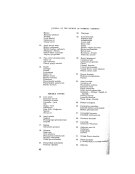
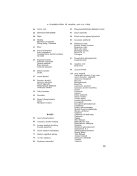
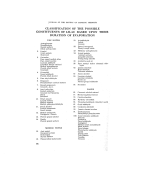
JOURNAL OF THE SOCIETY OF COSMETIC CHEMISTS by the olfactory nerves from the lowest note of patchouli, to the highest of civet or verbena. To obtain a perfectly fragrant blend he suggested it was only necessary to combine the harmonious chords. It was not until 1927 that Crocker and Henderson published their work on this subiect in America. They analysed and classified the odours on a numerical basis, and tried to find the elements of smell that make up all odours. They concluded there were four kinds only' fragrant or sweet acid or sour burnt or empyreumatic and caprylic or cenanthic. These assiduous chemists arranged several hundred pure chemicals and some essen- tial oils according to the relative amounts of each component, to each of which they assigned a figure or coefficient that noted the intensity of that domportent. Thus Jasmin was 6.3.3.3. and Orange 6.5.1.2. If these three classifications were seriously considered by the modern perfumer, he would be bound to give the palm to Piesse but I think it would be fair to say that he would find none of them of much use in the olfactory analysis of perfumes, or of their creation. In more recent years further attention has been paid to this problem by different research workers, whose investigations have proceeded much on the same lines as my own of nearly thirty years ago ß namely, by grouping the synthetics in particular, together with some essential oils, according to their comparative volatility. But no attempt appears to have been made to give practical application to this valuable data, and later in this paper I shall attempt to elaborate my theories in such a way that they will offer some real assistance to the creative perfumer. My first thoughts were directed to the molecular weights of the synthetics and natural isolates, but after tabulating them progressively I soon realised they could not reveal the secret of my quest. I next turned my attention '• to their boiling points at 760 mm., but even these, when tabulated, did not .. appear to solve my problem whereas when taken at a pressure of 3 ram.,. which approximates more nearly the vapour pressure at room temperature, the answer seemed within my grasp. • • However, the essential oils and flower extracts did not respond satis, .. factorily to this method, owing to their complex composition, and since they ,. are the indispensable tools in the hands of every perfumery researcher I compelled to adopt the only alternative, which consisted of the laborious i? estimation of their Duration of Evaporation by oilaction, at a laboratory:i? temperature of 16 ø C. This was going to take much time and patience, I felt it was the only method, which of course depended upon the reliability ii:i of my nose. Moreover, if I should succeed it might incidentally throw brighter light on the dark problem of fixation. And here I must draW.•?• attention to a most important point namely, the great improvement that.:• has since taken place in the production, processing and purification of aRii aromatics, so that the results of my work may require adjustment audi

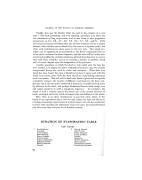
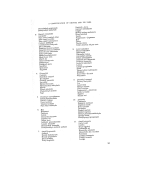
A CLASSIFICATION OF ODOURS AND ITS USES modification to-day. I hope that after the publication of this paper some interested perfumer will have the inclination and be prepared to give the time and patience that will be necessary in undertaking this work. A prerequisite of this investigation was the careful selection of the finest and purest substances, both natural and synthetic, and this involved the repeated examination of all known aromatics from every available source. In view of the cleverness of sophistication, especially of the more expensive materials, this proved to be a long and trying piece of work. But I was fortunate enough to be able to obtain many of the natural products on the spot, in the various countries I visited, which thus guaranteed their purity. Having selected and collected this vast array of priceless bottles, the next step was to decide on what should be the end point of the odour of the contents of each for as is well known, the characteristic note of some natural products may be fleeting while the residual smell lingers on. But since each aromatic substgnce is employed primarily for its typical odour note, I decided to check and re-check the point at which this distinguishing feature disappeared. Moreover, I had to place a time limit on those sub- stances of longest duration, such as patchouli and oakmoss, and I gave them the figure or coefficient of 100. My next step was the acquisition of a large stock of smelling strips, measuring 6 inches by -• inch, all made from the same stock of absorbent paper, and on each I wrote the name of the substance, the date and time of its application. It was important to have approximately equal quantities of the aromatics on the strips, but had I attempted to weigh exactly 100 milligrams of each, or calculated the differences due to their specific gravities, it would have added a further complication which I wished to avoid and moreover, I felt it would not materially influence the time coefficient if I dipped quickly each strip to a depth of exactly one inch. Nevertheless, I made some preliminary tests to determine the differences, and while making no allowance for viscosity found the weights of the majority ranged between 80 and 100 milligrams, with an ultimate length of stain of about 2« inches. This method seemed reasonably satisfactory for the liquids and I adopted it, but I still had to find another method for dealing with the solids, which of course are invaluable and widely used. I therefore prepared 10 per cent solutions of them all in diethyl phthalate, and placed 1 c.c. of each on strips of paper measuring 6 inches by 1 inch, which gave me about the same quantity of each parent substance as the fluids. As a guard against olfactic fatigue I limited the number of samples under examination to four a day, and began by smelling them every hour on the assumption that this figure or coefficient would be adequate. But when I found that most of them exhaled their characteristic odour for days on end I had to modify this view, and to those that evaporated in less than 83
Purchased for the exclusive use of nofirst nolast (unknown)
From: SCC Media Library & Resource Center (library.scconline.org)