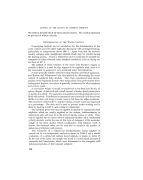
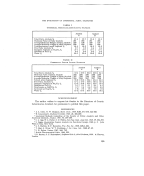
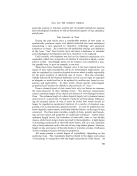
WAX AND THE COSMETIC CHEMIST power of microcrystalline waxes for oils, solvents and crystalline waxes (such as, for instance, paraffin wax). Various types and grades of micro- crystalline wax and of paraffin wax show great differences in this respect and thus in their commercial value. The paste-index and -consistency methods evaluate the hardness (firm- ness) and consistency of pastes made from a particular wax. This, too, is of technological and commercial importance. The viscosity of a wax relates to its molecular (or particle) size and shape, and serves as a further identification and evaluation test. The determination of melting and setting points of a wax (both of them appropriately chosen from the great number of available methods) and of its hardness provide further useful information. The same tests should or could be carried out with a seri•s of mixtures of the wax concerned with paraffin wax. The physico-analytical examination comprises mainly the use of chroma- tography and of urea-complex formation. By means of chromatographic methods it is often possi. ble to separate a wax into its major components and/ or to detect adulterants (for instance, added hydrocarbons in carnauba wax). Urea selectively forms complexes with certain types of compounds (for instance, with straight or little branched chai•s, but not with others). Thiourea has the opposite effect. It is hoped that both methods will be further developed, but already, although only fairly recently applied to waxes, they have been found most useful. Repeated freezing and thawing of emulsions (and preferably estimating also changes, i.e., increase, of particle size by means of turbidimetric examina- tions) will inform about their keeping properties. A similar effect can be achieved by placing emulsions for several hours in an incubator (say, at 35 ø C.) examining them warm and after cooling to room temperature. Regarding details of the methods discussed, reference must be made to published literature. s In connection with the definition of wax, it was stated that they form gels, pastes or mixture masses in conjunction with organic solvents. These three physical systems are representative of specific types of wax, namely (in the same order of listing) microcrystalline wax, paraffin wax and car- nauba wax wax mixtures give rise to further characteristic systems. For details reference must be made to published work.* • Ivanovszky, "Waxes in the Cosmetic Industry," S.P.C. Year Book, 1954. • Ivanovszky, "Wachs-Enzyklopaedie," Volume I, Augsburg, 1954. a Ivanovszky, "Wax Chemistry and Technology," London-Bridgend, 1952 {and the references listed therein) "Wachs-Enzyklopaedie," Volume II (in preparation) in addi- tion, J•ette u. S•ifen, 54, 275-279, 559-562 {1952) 55, 224-229, 302-308, 384-388, 444-448 (1953) Erdoel u. Kohle, 6, 787-791 (1953). • Particularly "Wachs-Enzyklopaedie," Vol. I, and Fette u. Seifen, 55 (1.c.). 139
Purchased for the exclusive use of nofirst nolast (unknown)
From: SCC Media Library & Resource Center (library.scconline.org)