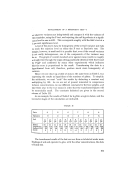
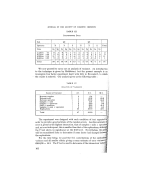
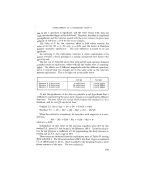
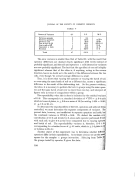
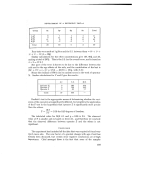
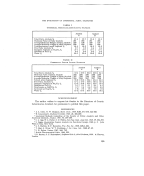
JOURNAL OF THE SOCIETY OF COSMETIC CHEMISTS interactions, in particular neither that of samples x operators nor of samples x soils, is significant. This means that, though different operators and soils produce different results, the effects are the same with all samples when expressed in logarithmic units. The last phrase is the essence of the matter. Different operators or tests with different soils may show variations in the differences between two detergents, but in logarithmic units the differences are constant, implying that it is the ratio of the numbers of plates that should be used as a com- parison of different detergents. Thus it is seen how a single experiment designed in accordance with certain basic statistical principles, but requiring no prior knowledge of the sort of results to be expected, can evaluate a test procedure and provide information concerning: (1) The interpretation of the data: e.g., the ratio of numbers of plates for different detergents is constant whereas the actual differences between numbers of plates may vary with operator and sample. (2) The repeatability of the test: this is proportional to the result, but is, therefore, constant in logarithmic units. It is q- 0.8 plates in 10 and q- 1.6 in 20, etc., or in other terms, the coefficient of variation is 8 per cent. (3) The precision of different operators: none of the three differs appreciably from the others. (4) The effect of uncontrollable variables: different batches 'of soil produce different results and even the same batch gives different results on different days. FURTHER STUDY OF SOIL AND OPERATORS A large number of different types of soil, both synthetic and natural soil from a works canteen, were examined. Although some workers have claimed that certain detergents are more efficient than others for particular types of soil the data collected in these tests did not support the claim. The ' ratio of number of plates for two detergents was substantially the same whatever soil was used. Even with the simplest soil (spreading the fat "Trex" at 2 grams per plate, without any warming, mixing or other treatment), a day-to-day variation larger than that within days was found. Work to find a reproduc- ible soil is still proceeding, but present evidence is that all detergent com- parisons must be made in groups using the same supply of soiled plates, and that the nature of the soil on the plates is unimportant. Consequently, artificial soils are used for routine tests only when insufficient naturatly• soiled plates are available. ':i ß

Concerning operator differences, it was noticed that an improvement in ß :i•'. precision occurred over the initial period of seven days or so, but then a slow .: deterioration occurred. The error variance in the units used above fell from .' 50 to about 20 (the value of 7.7 for operator Z was never found again) and then rose to 30-40 after the operator had been engaged on the work for a :::' :': month or so. The acquiring of a reproducible and rhythmic washing tech- nique followed by a decline in care and attention as interest waned would account for these results. The higher the repeatability that obtains the fewer the tests that need to be performed, and if the operators can be led to appreciate this point then reasonably high precision ought to be maintainable. REFERENCES • Clifford Pugh, Applied Statistics, 2, 172 {1053). • A. W. Middleton, •[.S.C.C., III, 253 (1052). a D. S. McArthur, E. L. Baldeschweiler, W, H. White, J. S. Anderson, Anal. Chern., ß ::::2•: 26, 1012 (June, 1954). 4 K. A. Brownlee, "Industrial Experimentation," H.M.S.O., 1949 (a) pages 38-9, ': (b) pages 111-114. A Lecture delivered to the Society on 22nd October, 1954
Purchased for the exclusive use of nofirst nolast (unknown)
From: SCC Media Library & Resource Center (library.scconline.org)