JOURNAL OF THE SOCIETY OF COSMETIC CHEMISTS 0 to 1, we shall find that although the odour of the major portion will be modified by that of the minor, the latter will last long after the former has evaporated. Furthermore, if we take an already blended perfume containing patchouli and coumarin, and substantially increase their percentages, •ve may find an overall increase in the lasting properties of the fragrance, but there would also be a shading of the note of the bouquet which might well spoil its lift and balance. This brings me to the vexed question of fixation, to which I shall refer only briefly as it is incidental to the main theme of this paper. The problem of tenacity is as old as scents themselves, and was mentioned by Theophrastus as long ago as 370 B.c. when, after classifying them as light, heavy, weak and strong, he concluded by saying of such things as myrrh and spikenard' "owing to their strength and substantial character they do not easily evapor- ate and are not easily made to disperse, and a lasting perfume is what women require." I think we may safely assume that this ancient philosopher was the first to realise the implications of vapour pressure without knowing anything about it. Moreover, his womenfolk correctly assessed one of the most important qualities of a. fragrance, which has not changed with the passing of the centuries. In the first place, what is understood by fixation ? Is it the retarding of the rate of evaporation of the more volatile substances in an already blended mixture of aromatics, by the addition of odourless, or nearly odourless, substances of high boiling-point ß or is it the skilful blending of aromatics of low volatility, which not only largely contribute to the note of the perfume, but also inhibit the loss of the less tenacious middle and top note constituents? I think the tyro would accept the first premise, and the expert the second mainly on the grounds that low vapour pressure solvents, such as diethyl phthalate and benzyl benzoate, have a distinct tendency to flatten the lift of a fragrance, and especially so if they are added in sufficient quantity of function as real fixatives. You may, of course, regard this opinion as mere speculation, based upon long years of perhaps unconscious observation. So, with the sole object o[. proving or of disproving this belief, I made the following experiments. first object was to discover which of the so-called "fixatives" delayed evapora -' .. tion for the longest period, and for this purpose I chose benzyl alcohol/i B.?. 68 C at 3 min. ß diethyl phthalate, B.?. 143 C at 3 ram. ß and benzyl•ii.i benzoate, B.?. 147 C at 3 mm. pressure all of which are cheap and readily?i available. I would say, in passing, that I included benzyl alcohol becaus?• it is not an uncommon constituent of floral compounds. But these by no means exhaust the list of usable substances, many of which I enuraer•:-!• ated on page 86 in Volume II of the sixth edition of my works. I selecte/i::ii two top-note aromatics owing to their greater volatility: acetophenone,':• ii essential oil of relatively compleX' straight synthetic, and bergamot, an ::.•

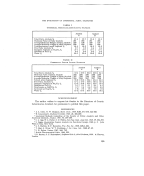
A CLASSIFICATION OF ODOURS AND ITS USES composition together with a first-grade lilac compound containing the ingredients I shall shortly mention. To each I added 10 per cent of the "fixatives," and then placed approximately 100 milligrams on smelling strips, making four in all of each aromatic. The first smell clearly revealed the superiority of the pure substance, and by comparison the flattening effect of the additions it was particularly noticeable in that containing the benzyl benzoate, which also imparted a rather metallic nuance. The strips were examined at regular intervals until the parent substance had evaporated, when it was clear that the odour strength of the other three were in direct ratio to the vapour pressures of the additions: thus, that containing benzyl benzoate was the strongest diethyl phthalate less so and benzyl alcohol the weakest. But the remark- able thing about these tests was that this rearrangement of strengths took place in one hour with the acetophenone in six hours with the bergamot and in fifty hours with the lilac. Having, therefore, proved the superiority of the benzyl benzoate, I went a step further by adding it in the percentages of one, five and ten to anisic aidehyde and ylang ylang oil aromatics of the middle note according to the classification, the one of straight and the other of complex composition. In each example the pure substance was preferred on first smelling, followed by those of 1, 5 and 10 per cent additions. But since these two substances are inherently more lasting than acetophenone and bergamot, the weakening of their odours was less rapid in fact, at the end of ten hours there was no change in the order of preference. It was only after fifty hours that a differ- ence in the odour strength of the synthetic was noticeable, and then in the following order: (1) the 10 per cent addition, (2) the 5 per cent, (3) the pure substance, and (4) the 1 per cent addition whereas in the meantime the fragrance of the essentiM oil maintained its original order of preference. Furthermore, I made parallel experiments with a Yardley perfumed cologne, which has a wide sale on this continent and contains many long- lasting ingredients. In order to decide whether the diluent of ethyl alcohol played a part, if any, in the duration of evaporation of the whole I made the same tests with the compound. The first smell confirmed the superiority of the "unfixed" perfume and compound, and no change could be observed up to fifty hours when the perfume containing 1 per cent of benzyl benzoate assumed first place, while those with 5 and 10 per cent additions still occupied third and fourth places respectively, but owing to the greater concentration of the compound the pure product retained first place after this time. Finally, I smelt the range of perfumes on the skin, when that containing no added fixative was predominantly fragrant. It would appear, therefore, that these high-boiling odourless "fixatives" exert a definite delaying action on the evaporation of the top-and middle- note synthetics, but they do so at the expense of the freshness and lift of the 87
Purchased for the exclusive use of nofirst nolast (unknown)
From: SCC Media Library & Resource Center (library.scconline.org)