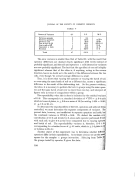
JOURNAL OF THE SOCIETY OF COSMETIC CHEMISTS for short) is a very progressive body in which the emphasis is on close technical collaboration aimed at improvements in quality and production efficiency. Its main committee is assisted by subcommittees covering specific subjects--Technical (i.e., mainly production and engineering), Publicity, and Chemists. It is as chairman of the latter that I speak to you to-night as part of a scheme developed by the Publicity Committee for extending the use of tubes. We feel that our accumulated experience in helping to solve the problems of customers over past years should be brought to the notice of those who carry the responsibihty for safely packaging the products of their own companies. If our advice is sought at an early stage during the preliminary preparations for marketing a new product, or even changing the existing pack for something already well known to the public, it is often possible to avoid disappointments in behaviour or finished appear- ance. We do not claim to be infallible, but we do know our own limitations and those of our product fairly well. Why does one choose a tube for a given product ? No single reason can ever supply the answer it will be a combination of various considerations ' (a) Convenience of the consumer. (b) Protection of the product against deterioration during its shelf life and, equally important, during the period of its actual consumption, which may be spread over several months. (c) The need for a container of limited capacity. (d) Visual appeal of the pack. (e) Cost. Once the manufacturer has decided that a tube is the most acceptable pack for his product he has then to consider practical details. (1) Dimensions. No trouble here, since tables are available showing the). ! , capacities of tubes of different diameters and lengths. These are so arranged as to ensure that the relationship between length, diameter and capacity ism:. such as to give a tube of normal proportions. A range of nozzles is available :' to cope with wide variations in consistency as well as specialised applications. i:! (2) Which Metal ? It is necessary to deal with this question at much-• greater length since it is probably the most vital choice which has to be In one respect it is not exactly a free choice, since economic consideration s• tend to eliminate the favourite. The metals available with rough comparative costs per gross, for a 1 diameter tube are: (a) Aluminium 22/6 (+ 3/- if Araldited) (b) Tin 39/- (c) Lead 21/- (d) Alloys of Tin and Lead • (e) Tin-plated lead 24/6 108

THE COLLAPSIBLE TUBE ALUMINIUM (99'7 per cent purity) It is only since the end of the second world war that aluminium has been used in any quantity. It now constitutes well over 50 per cent of the total output, and this phenomenal rise is due to four factors. First, th• production of this metal increased enormously under the impetus of war, and the cessation of hostilities left the world with abundant supplies at comparatively low prices. Secondly, the war had adversely affected the supply of tin, with the result that its market price rocketed upwards to a peak exceeding •1,600 per ton. It has since fallen appreciably, but even now it is only just below oe740. Thirdly, advances in the chemistry of surface- coating resins had produced internal lacquers with excellent chemical resistance, good adhesion to aluminium, and a high degree of flexibility. Fourthly, chemists have shown considerable skill in finding corrosion inhibitors and in making modifications in product formulae. The tube manufacturer had his own difficulties in this change-over to aluminium, but they were eventually overcome. You, as the packer, are only interested in the service which each type will give you. Physically, the aluminium tube looks almost as good as the tin tube and far better than a lead tube. In use, it inevitably feels somewhat harsher than the familiar tin tube. Vickers Pyramid Diamond Hardness measurements reveal that it has a V.P.N. of 20 compared with 14 for tin and about 10 for lead, as used in tubes. Nothing can be done about this, and even when the manufacturer takes the utmost precaution to see that his tubes are fully annealed, there is a further effect which tends to emphasise this fundamental difference. As all of you know, collapsible tubes are impact-extruded from a slug of metal. The forces involved are very high and the whole operation is over in a fraction of a second. Where a metal work-hardens, as does aluminium, considerable heat is evolved, and a cold slug becomes a very rigid tube too hot to hold in the hand. Because of this behaviour it requires a larger press for a given size of tube than does tin or lead. The wear on the extrusion tools is likewise proportionately greater. Now a set of extrusion tools can cost from •15 to •20 to make, and one has to get the best possible life out of them. As the tools wear, and the edge of the punch is more susceptible than the wall of the die, the wall thickness of the tube increases steadily, since the annular gap between punch and die is enlarged. One thus starts at 4 thou., which is the minimum satisfactory wall thickness, and works up to the maximum limit of 6 thou., before replacing the nose end of the punch. After several such replacements the wall of the die requires attention but if it has been made to give a tube with an overall diameter on the minimum limit, it is possible to resurface the wall of the die, thereby increasing its diameter slightly, and work it again with correspondingly larger punches over the 4 to 6 thou. range. Assuming that the overall diameter tolerance is q- 4 109
Purchased for the exclusive use of nofirst nolast (unknown)
From: SCC Media Library & Resource Center (library.scconline.org)