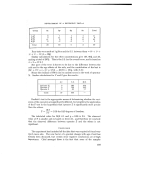
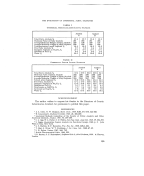
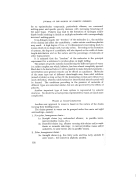
THE EVALUATION OF COMMERCIAL ALKYL SULPHATES R. H. CROCKETT* Analytical methods lor the analysis o! detergents [or alkyl sulphates are detailed. Duplicate results obtained by two analysts, using the methods on two different types oi detergent, are tabulated: they show that the accuracy o! the methods is excellent. THERE HAS been a number of publications concerning the identification and analysis of many types of commercial detergents dealing mainly with the qualitative identification and the determination of the active material. The scheme of Gilby and Hodgson • is based upon a study of some forty commer- cial products and includes a modification of Linsenmeyer's.` method for the identification of eight types of surface-active agents. The Analytical Methods Committee of the Society of Public Analysts and Other Analytical Chemists" give a procedure for the examination of various types' of detergent preparations, including both qualitative and quantitative methods of pro- cedure for the active principle. All these methods deal with detergent preparations in a generalised way, but do not appear sufficient for the evaluation of a raw material which is to be used as a basis for manufacture of various products. The commercial alkyl sulphates are widely used in industry at the present time as wetting agents, as raw materials for the manufacture of laundry and household detergents and for the manufacture of soapless hair shampoos of various types. They usually consist of a mixture of the active detergent with some unsulphated alcohols, inorganic sulphates, inorganic chlorides and water. An evaluation of the raw material is essential for the control of any product for which it forms a basis of manufacture. The procedures given heie are for the purpose of obtaining data to indicate the composition, and include the determination of the hydroxyl value of the fatty alcohols. This value is used as a basis for the calculation of the molecular weight of the alkyl sulphate. DETERMINATION OF THE T•)TAL FATTY ALCOHOLS The alkyl sulphates are quite easily hydrolysed by refluxing with approx- imately 2N sulphuric acid and it is an advantage to obtain the bulk of the fatty alcohols without treatment with solvent so that there is no loss of the more volatile alcohols during the removal of the solvent, and hence no effect on subsequent analysis. A weight of 25 gms. of the sample is transferred to a 500 ml. flat-bottomed Quickfit flask and dissolved in 200 mls. of approximately 2N sulphuric acid. * County Laboratories, Ltd., Honeypot Lane, Stanmore, Middlesex. 124

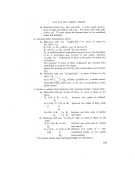
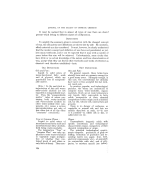
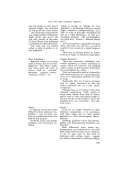
THE EVALUATION OF COMMERCIAL ALKYL SULPHATES The flask is connected to a Quickfit condenser and the contents kept just on the boil until the fatty alcohols separate quickly as a clear layer after swirling the flask. The condenser is washed down with hot distilled water, the fatty alcohols separated in a separating funnel and the aqueous layer removed. The fatty alcohols are washed twice with hot 25 per cent sodium chloride solution and then transferred to a weighed flask without the use of solvent, cooled and weighed and retained for subsequent analysis. The small amount of fatty alcohols left in the original flask and in the separating funnel is transferred to a second weighed flask with ether, the solvent is removed and the total weight of fatty alcohols is obtained by adding this weight to the main bulk. In this way the bulk of the fatty alcohols is obtained without contamination by solvent or loss of the more volatile constituents. The result is expressed as a percentage of total fatty alcohols. DETERMINATION OF THE I-IYDROXYL VALUE OF THE FATTY ALCOHOLS The method of Ogg, Porter and Willits * based on esterification with acetic anhydride is satisfactory. Full details of the general application of the method are given by Siggia. 6 The determination is carried out in duplicate and a quantity of between 0-5 gm. and 1 gm. is accurately weighed into each of two 250 mi. conical flasks fitted with glass stoppers. A volume of 5 mls. of acetylating reagent is pipetted into each of the flasks and a further 5 mls. into a third flask for the blank. The stoppers of the flasks are moistened with pyridine and loosely inserted into the flasks, which are then heated on a water bath for one and a half hours. After this time 10 mls. of distilled water are added to each flask and the contents are mixed and allowed to stand for two minutes. The flasks are cooled and 10 mls. of n-butanol added to each, rinsing the stopper and sides of the flasks during the addition. The contents of each flask are titrated with approximately 0.5N alcoholic potassium hydroxide solution using cresol red-thymol blue indicator. The alcoholic potassium hydroxide solution .is standardised with 0.SN hydrochloric acid. Hydroxyl Value = (Blank--Sample) rots. KOH x F x 56.1 Wt. Sample taken. where'F is the normality of the alcoholic potassium hydroxide. The acetylating mixture consists of one part acetic anhydride with three parts of pyridine. The cresol red-thymol blue indicator cons'ists of one part of a 0'1 per cent aqueous solution of cresol red neutralised with 0'IN sodium hydroxide, and three parts of a 0'1 per cent aqueous solution of thymol blue similarly neuiralised. The average molecular weight of the fatty alcohols and hence of the alkyl sulphate is calculated from the hydroxyl value. 125
Purchased for the exclusive use of nofirst nolast (unknown)
From: SCC Media Library & Resource Center (library.scconline.org)