THE EFFECT UPON EMULSIONS OF THE HYDROXY COMPOUNDS IN BEESWAX tank may cause these slight variations. If possible, the number of broken seals and opened containers should be kept to a minimum. In conclusion, one may say that although general hints such as have been given above can be of service in the buying of essential oils, there is a lot to be said for the good will and the good name of the seller, and the old adage that the high standing of the firm and high reputation on the label is as good a guarantee of quality as one can obtain from chemical tests. THE EFFECT UPON EMULSIONS OF THE HYDROXY COMPOUNDS IN BEESWAX J. PICKTHALL, F.R.I.C.* Work is described in which the role of the hydroxy compounds in beeswax is demonstrated. It is found that these play an important part in the emulsi- fication behaviour of the wax and attention is drawn to the resultant value of the acetyl value as a beeswax constant. A STUDY of the literature does not p• oduce a very lucrative yield of informa- tion on the composition of beeswax. The following information has been gleaned from various sources. 1. "Chemically, beeswax is composed of myricyl palmirate, cerotic and homologous acids with small amounts of hydrocarbons, cholesterol esters and ceryl alcohols, pollen and resins. The presence of resins in undue amounts renders bleaching difficult. The free fatty acid content is an important factor in emulsifiability. Properties: Melting point 145-158 ø F. Specific gravity 0.952-0.975 Acid number 16.6-20.7 Saponification number 90-96 Unsaponifiable matter 52-56% Iodine number 4-12 Acetyl number 15.1 Ester number 72-78 Ester-acid ratio 3.6-4.2 Colour white, yellow, brown Refractive index (75 ø C.) 1.4398-1.4451 Odour honey Dielectric constant 3.1-3.3 Effective A.C. conductivity 70-86 Volume resistivity 0.9-1.5 *Polak and Schwarz (England) Ltd., Enfield, Middlesex. 263

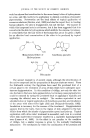
JOURNAL OF THE SOCIETY OF COSMETIC CHEMISTS When beeswax is heated to 150-250 ø C., the acid number decreases while the ester number and saponification number increase. Continued heating causes re-esterifi. cation or estolide formation with decrease of ester and saponification numbers." 2. "Esters of long chain acids 72% ½holesteryl esters 0.8% Lactones 0.6% Free acids 13% Hydrocarbons 12}/o Water 2% The esters have a saponification equivalent of about 700 with a melting point of 63 ø C. and contain: 33% myricyl palmitate 12ø/0 myricyl palmitoleate 12% myricyl cerotate 9ø/0 lacceryl palmitate 6ø//0 myricyl hydroxypalmitate (myricyl alcohol C80H0•OH) Free acids equivalent 377. Melting point 78 ø C. Neocerotic C •sH 500 • Cerotic C• 7H5•O• Montanic C•0H580, Melissic Cs,H 6sO • Hydrocarbons mainly hentriacontane C,•H •* Melting point 68.7 ø C." * Probably an error, Karrer gives CaxH½½. Most specifications for beeswax quote acid and ester values with emphasis on the ratio number (ester value divided by acid value), but there is a notable absence of acetyl values. This work was prompted by the thought that certain hydroxy compounds (alcohols and polyglycols) play an important part in emulsification technique. For example, cetyl alcohol, woolwax alcohols and glyceryl monostearate, when used with soaps or alcohol sulphates, act as efficient oil-in-water emulsifiers. Now beeswax has quite amazing properties when employed in emulsions. For instance, in the presence of a base, whether caustic alkali, trlethanolamine, borax or lime water, emulsions of unusual properties are obtained. Its properties in this direction are very well known, even if its exact function is not. It seems unlikely that when a base--say, triethanolamine or caustic soda--is reacted with beeswax to produce an emulsion the total emulsifying effect depends only on the soap formed. Borax, when used as the reacting 264
Purchased for the exclusive use of nofirst nolast (unknown)
From: SCC Media Library & Resource Center (library.scconline.org)