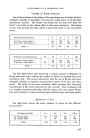
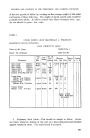
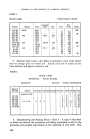
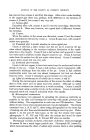
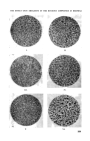
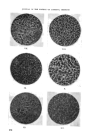
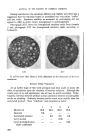
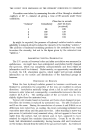
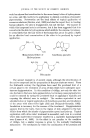
THE EFFECT UPON EMULSIONS OF THE HYDROXY COMPOUNDS IN BEESWAX emulsifiers which are responsible for the peculiar properties of beeswax. Regrettably, little published information on the nature of "alcohols" in beeswax is to be found. In order to determine the effect of the beeswax alcohols on emulsions made from this wax the free hydroxyl groups were blocked by acetylation. Although we are now dealing with a changed ratio value it has been shown that acetylated beeswax lacks many of the adrnirable emulsifying properties of the untreated wax. A cold cream made from the acetylated wax possesses larger particle size and is relatively unstable when compared to the normal cold cream. To some extent the performance of this cream can be improved by re- introducing compounds which contain hydroxyl radicles. It would appear that cetyl alcohol is too oil-soluble and the ethylene oxide condensate too water soluble adequately to replace the alcohols removed by acetylation. Further work (unpublished) has shown that a careful selection of other hydroxyl compounds used in their correct proportions in conjunction with acetylated beeswax will lead to a cream quite as good as the cream made from the untreated beeswax. In fact, it is fair to say that the additions have, in some respects, resulted in creams with improved properties. Cream A, which may be regarded as a "normal" cold cream, can be greatly improved in many ways, e.g., smaller particle size, attractive appearance, inhibition of water-loss, stability of the emulsion, by the addition of small amounts of hydroxyl-containing materials. The fact that acetylation does not greatly affect the properties of beeswax as a w/o emulsifier is not surprising. The formation of calcium soaps with the beeswax acids results in a reasonably efficient w/o emulsifier and its properties would not be greatly influenced by small additions of alcohols. The above work indicates that the rather unusual emulsifying properties of beeswax depend to some extent upon the presence of alcohols or, at any rate, compounds which contain hydroxyl radicals. This effect does not appear to be generally recognised and certainly little attention is given to it in the literature. It is therefore suggested that more attention could be given to the acetyl value of beeswax during analysis and general estimation of its properties. I acknowledge with thanks the laboratory experiments undertaken by Mrs. P. Mitchell and Miss E. Parmenter, and the general help and ad¾ice given by Mr. Geoffrey Pickthall, especially as far as the photomicrography is concerned. 275

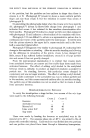
THE SKIN AS A COMMUNITY OF STRUCTURES E. W. POWELL, 1VI.A., A.R.I.C.* In l•art II of his article the author discusses the formation ot • skin l•igments and ot • hair. These two l•rocesses are carried out by cells of •wo distinct ty10es which respond ditterently to some topical influences, but are linked by certain common nutritional needs. PART II PIGMENT FORMATION AND KERATIN PRODUCTION IN THE SKIN THE PIGMENTS characteristic of the mammalian skin and its associated structures are the melanins, complex polymeric materials giving black, brown and red colours as well as providing the dark absorbing background for certain blues. It is now generally accepted that these materials are formed by the activity of certain specialised cells, the melanocytes. In or close to the basal layers of the epidermis and about the proliferating layer of the hair bulb are situated cells possessing a main body and branches. These are the pigment-forming melanocytes. In the skin, the two activities of keratin production and of the formation of pigment are, therefore, carried out by cells of two distinct types and of differing origins. ORIGIN AND DEVELOPMENT OF PIGMENT-PRODUCING CELLS During a relatively short period in the growth of the mammalian embryo there is associated with the rudimentary spinal cord a small amount of a tissue termed the neural crest. This is a transitory structure, for the constitu- ent cells disperse and move to positions where they lie at the interface between an epithelium and an underlying tissue. Such migration results in a fairly even distribution of these cells through the epidermis of the human fcetus, and when a hair follicle begins to develop they move down into the dermis with the descending follicle (Zimmerman, 1953). None of these former neural crest cells appear to remain in the upper part of the folhcle, and it is of interest that when sweat gland rudiments are formed none of these cells move down from the epidermis with them. In later development, these cells which have moved into the epidermis and hair bulbs can assume the branched form typical of nerve cells. The branches of these cells pass between the epidermal cells and end on them. When active, they produce a substance, dihydroxyphenylalanine, which is related to the noradrenalin formed in other nerve cells, and it is this substance which undergoes oxidation and poly- merisation during the formation of melanin. The melanin is passed along the branches of the melanocytes and is deposited between and also enters the epidermal cells. * 49, Barn Hill, Wembley Park, Middx. 276
Purchased for the exclusive use of nofirst nolast (unknown)
From: SCC Media Library & Resource Center (library.scconline.org)