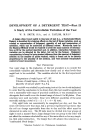
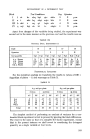
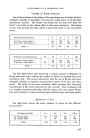
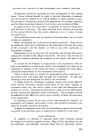
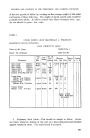
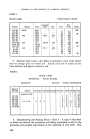
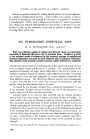
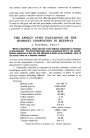
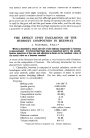
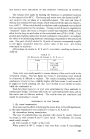
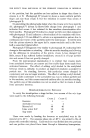
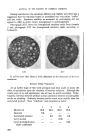
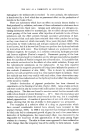
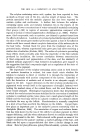
DEVELOPMENT OF A DETERGENT TEST Block I 1 at II a t III b abt IV q aqt Test Conditions Day Operator bv abq bqt qtv abtv 3 Z p.m. abv bq abqt aqtv btv 2 Z a.m. v aq qt bqtv atv 4 X a.m. bqt ab bt tv abqtv 1 X p.m. Apart from changes of the variables being studied, the experiment was carried out in the same manner as the previous one 6 and the results were as TABLE IX ORIGINAL DATA, EXPERIMENT 2 I Date 15 . 16 17 19._ Operator X Z Z X -- Soil quantity 4 gr. 8 gr. 8gr. 4gr. 4gr. 8gr. 8gr. 4gr. 4 g. Nansa 7t 6 6tv 13t 8tv 10t 6v 9 6 g. Nansa 13tv 9t 7v 15 11v 12 12tv 14t 9 g. Nansa 1By 11v 12 1Sty 17 15tv 13t 16v 13• g. Nansa 17 12tv 16t 20v 25t 13v 16 22tv STATISTICAL ANALYSIS For the statistical analysis we transform the results to values of 100 x (logarithm of plates --1) and rearrange as Table X. TABLE X 4 g. soil per plate 8 g. soil per plate 3 litres 4• litres 3 litres 4• litres 47 ø 55 ø 47 ø 55 ø 47 ø 55 ø 47 ø 55 ø -- 4 g. -5 11 -15 -10 -22 0 -22 -22 6 g. 18 15 4 11 8 -,5 -15 8 9 g. 23 26 20 18 8 11 4 18 13•g. 23 40 30 [ 34 20 20 11 8 Total 59 92 39 53 14 26 -22 12 The simplest method of performing an analysis of variance for a con- founded block experiment is first to proceed by ignoring the block differences. The result is the same as that of a complete five-factor experiment, except that in the present instance we shall revert to considering the detergent quantity as a single variable at four levels. 241

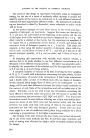
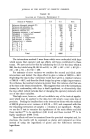
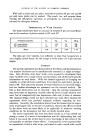
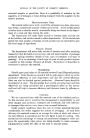
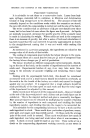
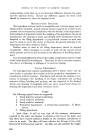
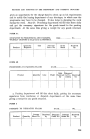
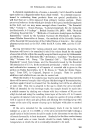
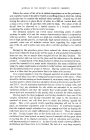
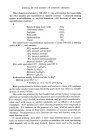
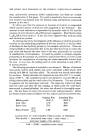
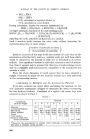
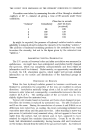
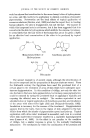
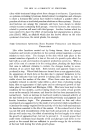
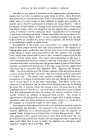
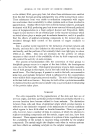
JOURNAL OF THE SOCIETY OF COSMETIC CHEMISTS TABLE XI ANALYSIS OF VARIANCE EXPERIMENT 2 Source of Variance d.f. S.S. M.S. Between detergent amount (D) 3 5189 1730 *** Between soil amounts (S) 1 1418 1418 *** Between temperatures (T) 1 270 270 ** Between volumes (V) 1 371 371 ** Detergent amounts x soil amount 3 39 13 Detergent x temperature 3 67 22 Detergent X volume 3 136 45 Soil amount x temperature 1 0 0 Soil amount x volume • 1 3 3 Temperature x volume 1 1 1 D X Q x T 3 108 36 C D x Q x V 3 100 33 C D X T X V 3 386 129C Q x T x V 1 52 52 D x Q x T x V 3 142 47 Total 31 8282 -- i The interactions marked C were those which were confounded with days which means that operator and age effects will have contributed to these terms. We now correct for this by calculating the S.S. for the days, which is 286, the day totals being 30, 68, 94 and 81, i.e. (30' q- 682 q- 942 q- 81')/8 -- (30 5- 68 q- 94 + 81)2/32 = 286. For estimate of error variance we combine the second and third order interactions and deduct the days effect to give a value of 502/10 = 50.2. Neglecting the day-to-day variations would have given a residual variance of 788/13 = 60.7, and thus the block design has given a slight improvement. Nevertheless, the residual variance is greater than the variance of all but one of the first order interactions above. This suggests that one of the interactions chosen for confounding with days is itself significant, or alternatively that the days effect (which includes that of changing the operator) interacts with one of the other variables. This high error, however, will not invalidate any of the tests of signific- ance which may be applied to the data but will simply cause some loss of precision. Pooling the smallest first order interaction terms with the residual of 502/10 gives an error variance of 612/19 = 32.2, and compared with this the remaining interaction of samples x volumes is not significant. Finally, we use the F test to examine the significance of the main effects and find those marked ** to be significant (0.01 level) and those marked *** to be highly significant (0.001 level). These effects will now be examined from the practical viewpoint and, for clearness, the results will be expressed as plates and compared as ratios instead of using the logarithms of plates and the differences between logarithms. 242
Purchased for the exclusive use of nofirst nolast (unknown)
From: SCC Media Library & Resource Center (library.scconline.org)