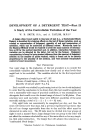
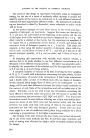
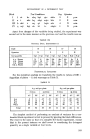
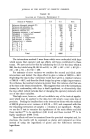
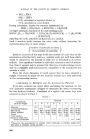
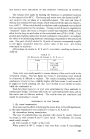
WHITE OILS provide only a rough indication of the nature of the main variables, and leave many doubtful points to be cleared up later. The experiment has shown that 32 tests are sufficient to distinguish the main effects of the four variables from the variance due to error, and has also shown that detergent concentra- tion is a better variable than detergency quantity, and the pilot experiment has thus served its purposes. But it has done much more than this and, exceeding all expectations, has established all the main effects at significance levels all better than 0.01, and shown all interactions to be non-significant. The largest interaction variation has not even reached a significance of p ---- 0-2, and as no effects are left as "probably significant" the investigation of the importance of the variables is complete. REFERENCES • K. A. Brownlee, "Industrial Experimentation," H.M.S.O. 1949 (a), pp. 154-161. ' \V. B. Smith and A. Taylor, J.S.C.C., VI, pp. 96-107. WHITE OILS H. PATON, A.I.C.S., A.M.INsT.P.* The early history of white off manufacture is outlineal, examples are given of its current wide use and reference made to the most recent spectro- scope technique for determ'min• its stability. THERE ARE many formulations of the cosmetic industry which contain white oil that is, hydrocarbon oil of petroleum origin, and it is this raw material which is the subject of this talk. White oils are, however, comparatively new entries into an art or science which has, at times, claimed the attention of priests, and even politicians, and of which there are relics dating back to 5,000 years ago. The petroleum refining industry is by contrast in its infancy. Research shows that there are very few aids to beauty to-day which have not had their counterpart in earlier centuries, but apparently it was not until the early 1900's that cosmetic compounding became really scientific. Strangely, or perhaps one of the reasons for the development, was the intro- duction of white mineral oils about the same time. To-day, of course, the cosmetic industry of this country holds a very important part in the national economy. It engages a large number of people, directly and indirectly, in its manufacture and distribution, and it has a rapidly increasing output both on the home and on export markets. * Manchester Oil Refinery Ltd., Manchester 245

WHITE OILS provide only a rough indication of the nature of the main variables, and leave many doubtful points to be cleared up later. The experiment has shown that 32 tests are sufficient to distinguish the main effects of the four variables from the variance due to error, and has also shown that detergent concentra- tion is a better variable than detergency quantity, and the pilot experiment has thus served its purposes. But it has done much more than this and, exceeding all expectations, has established all the main effects at significance levels all better than 0.01, and shown all interactions to be non-significant. The largest interaction variation has not even reached a significance of p ---- 0-2, and as no effects are left as "probably significant" the investigation of the importance of the variables is complete. REFERENCES • K. A. Brownlee, "Industrial Experimentation," H.M.S.O. 1949 (a), pp. 154-161. ' \V. B. Smith and A. Taylor, J.S.C.C., VI, pp. 96-107. WHITE OILS H. PATON, A.I.C.S., A.M.INsT.P.* The early history of white off manufacture is outlineal, examples are given of its current wide use and reference made to the most recent spectro- scope technique for determ'min• its stability. THERE ARE many formulations of the cosmetic industry which contain white oil that is, hydrocarbon oil of petroleum origin, and it is this raw material which is the subject of this talk. White oils are, however, comparatively new entries into an art or science which has, at times, claimed the attention of priests, and even politicians, and of which there are relics dating back to 5,000 years ago. The petroleum refining industry is by contrast in its infancy. Research shows that there are very few aids to beauty to-day which have not had their counterpart in earlier centuries, but apparently it was not until the early 1900's that cosmetic compounding became really scientific. Strangely, or perhaps one of the reasons for the development, was the intro- duction of white mineral oils about the same time. To-day, of course, the cosmetic industry of this country holds a very important part in the national economy. It engages a large number of people, directly and indirectly, in its manufacture and distribution, and it has a rapidly increasing output both on the home and on export markets. * Manchester Oil Refinery Ltd., Manchester 245
Purchased for the exclusive use of nofirst nolast (unknown)
From: SCC Media Library & Resource Center (library.scconline.org)