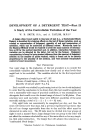
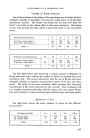
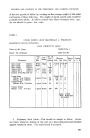
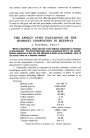
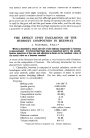
THE EFFECT UPON EMULSIONS OF THE HYDROXY COMPOUNDS IN BEESWAX base, undoubtedly introduces added complications, but these are outside the consideration of this paper. The point in question is, have we an associa- tion between soap formed from the beeswax acids and hydroxy compounds present in the wax ? It will be seen that the presence in beeswax of alcohols or compounds which contain hydroxy radicals has been suggested in the literature. The amount of such substances is represented by an acetyl value of 15.1 and the presence of ceryl alcohol C27H•,OH has been suggested. (Paul Karrer gives C26H•30H for this alcohol.) It has also been suggested that hydroxy acids and alcohols are present. An obvious step in the investigation of the influence of alcohols present in beeswax on the emulsifying properties of the wax would be to try the effect of blocking the free hydroxy groups by, for example, acetylation. There are certain pitfalls in this procedure due to the fact that heat tends to reduce the acid value and increase the ester value of the wax, presumably by a process of esterification or lactonisation. It would be possible to attempt complete acetylation in the presence of a solvent to reduce heat effects, but this would introduce the complication of removing the water-immiscible solvent from the wax. In any case, the boiling point of acetic anhydride is only 138 ø C. at normal pressure. The following procedure of acetylatim) was adopted: 300 gm. of beeswax were gently heated until molten and acetic anhydride added slowly with stirring until 200 ml. had been added The mixture was heated under reflux for one hour. During this time the temperature rose from 119 ø C. to a maxi- mum of 139 ø C. The acetylated product was allowed to cool and 300 mi. of boiling water added and the whole stirred for 10 minutes This was allowed to separate and the water-layer removed. The mass was washed six times with hot water and after the last washing, at which point the wash-water was neutral to phenolphthalein, the water was allowed to thoroughly separ- ate. The last traces of water were removed under reduced pressure. Below are shown certain analytical figures for the original and the acetylated wax. Original Wax A cetylated Wax Melting point 63.4 ø C. 63.0 ø C. Acid value 17.9 16.6 Ester value 75.2 90.6 (E.V Ratio Number 4.20 5.46 A.V) CALCULATION OF ACETYLISABLE FREE-ALCOHOL IN BEESWAX Free alcohol = (acetylated ester value - ester value) x molecular weight of the alcohol. 0.42 x (1336 - acetylated ester value) 265

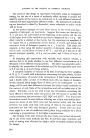
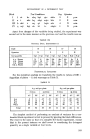
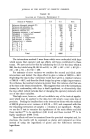
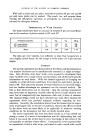
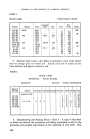
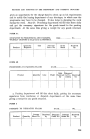
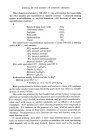
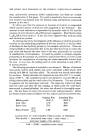
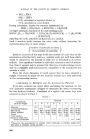
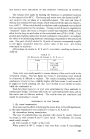
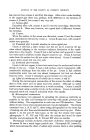
JOURNAL OF THE SOCIETY OF COSMETIC CHEMISTS 15.4 x 214.4 0.42 x 1245.4 = 6.3% calculated as myristyl alcohol or 7.1% calculated as cetyl alcohol. During acetylation, besides the reaction represented by' ROH + (CH,CO)•O --+ ROOCCH• + CH,COOH we might anticipate reactions of the acid-exchange type. R00CC•,H,• q-CH•C00H q- [(CH•C0)•0]-+R00CCH• q- C•H•COOH + [(cmco)2o] regarding the acetic anhydride [(CH3CO)20] as a catalyst. Such a reaction would increase the ester value without increasing the molecular proportion of esters present Numbe_____r of mol___ecu_les of este_•_rs Total number of molecules However, reactions of this type would also increase the acid value by the introduction of further fatty acid (e.g., palmitic acid), but both these effects would be reduced by the increase in bulk due to introduction of acetate radicals. If no significant increase in acid value occurs as a result of acetyla- tion, then it appears safe to assume that this type of acid-exchange occurs only on a negligible scale and hence the calculation of the acetylisable free alcohols is valid. From the above discussion it would appear that we have prepared a sample of beeswax in which the free hydroxy radicals have been converted to the corresponding acetate. COMPARISON OF BEESWAX AND ITS ACETYLATION PRODUCT If we have achieved our object when acetylating the beeswax, we can now undertake experiments designed to determine the effect of removing the free hydroxyl radicals. Emulsions of a typical cold cream type were prepared as shown in Table I. TABLE I Constituents parts by weight Beeswax Acetylareal Beeswax Mineral Oil Water, distilled Borax Cetyl alcohol *Ethylene oxide-cetyl alcohol condensate A 35-0 1.0 -- CREAM 35.0 1.0 C s•0 35'00 0'93 -- D l•o 50.00 35-00 0.93 E 49.0 35.0 1'0 1-0 F 147oo 49.00 35.00 0.93 1'00 G 49.0 35.0 1.0 H 14•oo 49.00 35.00 0.93 1'0 1'00 * Stated by the manufacturer to contain twelve molecules of ethylene oxide, but this figure is probably on the low side. 266
Purchased for the exclusive use of nofirst nolast (unknown)
From: SCC Media Library & Resource Center (library.scconline.org)