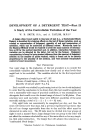
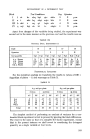
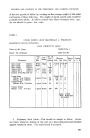
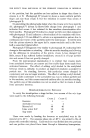
DEVELOPMENT OF A DETERGENT TEST VOLUME OF WASH SOLUTION One of the problems in the design of the experiment was to decide whether detergent quantity or detergent concentration would prove to be the more satisfactory variable. The former was chosen but the data now show the latter to be better as the volume effect is then more consistent. The means of four tests provide the data which is expressed below in the alternative forms: Detergent Quantity gms. 4 6 9 13i In 3 litres, mean plates -- 9•t 12•t 15 18• In 4« litres, mean plates -- 6• 10• 14• 16• , Ratio ---- .72 .86 .95 .91 Detergent Concentration g/1 .89 1« 2 13 4} In 3 litres, mean plates ---- -- 9•t 12•t 15 18• In 4•t litres, mean plates _-- 6• 10• 14• 16• -- Ratio _-- __ 1.14 1.14 1.12 -- The first table shows that dissolving a certain amount of detergent in 50 per cent more water reduces the number of plates by between 5 per cent and 28 per cent. The second table shows that the use of 50 per cent more detergent solution at constant concentration washes 12-14 per cent more plates. The latter is the more consistent effect showing that detergent concentration is the better selection for the variable. This conclusion will be a surprise to persons unfamiliar with the subject who may expect 50 per cent more solution to wash something approaching 50 per cent more plates. QUANTITY OF SOIL The table below shows the mean numbers of plates for the different soil quantities. Detergent quantity 4 g. 6 g. 9 g. 13] g. , , 4 g. soil per plate 9• 13• 16• 21 8 g. soil per plate 7 10 12• 14• -- Ratio 1.32 1.33 1.30 1.48 243

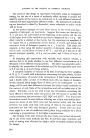
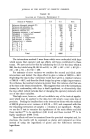
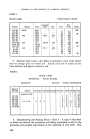
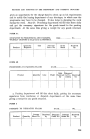
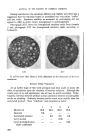
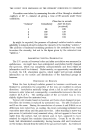
JOURNAL OF THE SOCIETY OF COSMETIC CHEMISTS With half as much soil per plate, somewhere between 30 per cent and 50 per cent more plates can be washed. This result, too, will surprise those viewing the detergency operation as principally an interaction between soil and the detergent solution. TEMPERATURE OF WASH SOLUTION The main results here show an increase of between 7 per cent and :t2 per cent in the numbers of plates washed at 55 ø with 47 ø . Detergent quantity 4 g. 6 g. 9 g. 13• g. 47 ø mean plates 7 11¬ 14 16• 55 ø mean plates 95 12 151 18// Ratio 1'32 1.07 1-09 1' 14 The data are very variable, but sufficient to show that temperature is not a highly critical factor, for the change is of the order of 1-2 per cent per degree. SUMMARY The second experiment has illustrated how the effects and the interactions of a number of factors can be simultaneously assessed in a single investiga- tion. Only 32 tests--four days' work--were required to investigate three main variables over a range of four concentrations, and all 32 results provide information on each factor. With the classical approach of changing one variable at a time 32 tests would have to be made for each factor, giving a total of 96. Not only is the amount of work reduced by our factorial design, but two further advantages are possessed over the classical method. The first is that interactions can be detected: thus the starting temperature may have been an important variable when 4i litres of wash solution were used, but of comparatively less importance with only 3 litres of solution. The classical design would not have detected any such effect, whereas the experiment above has provided adequate evidence regarding its non- existence. Secondly, the conclusions drawn from the former type of experi- ment would apply only to one set of conditions, whereas the effects revealed by the above work are more likely to be applicable to whatever working conditions for the detergency test that are finally decided upon. The above experiment has been described exactly as it was carried out during a course of a series of investigations into the dishwashing test, and before it was made the writers had no prior knowledge of the nature of the soil quantity or solution volume effects. Consequently, it was expected that an experiment of such a wide scope, performed on such a small scale, would 244
Purchased for the exclusive use of nofirst nolast (unknown)
From: SCC Media Library & Resource Center (library.scconline.org)