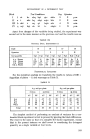
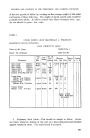
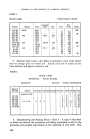
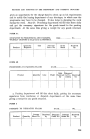
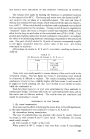
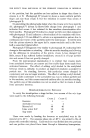
THE EFFECT UPON EMULSIONS OF THE HYDROXY COMPOUNDS IN BEESWAX The creams were made by heating the beeswax or acetylated beeswax in the mineral oil to 65 ø C. The borax and water were also heated to 65 ø C. and added to the oil phase at a controlled speed. The rate and time of stirring was constant for each cream, which was poured into jars at a tempera- ture of 45 ø C. When cetyl alcohol or ethylene oxide condensate was included this was incorporated in the oil phase. Creams A and B may be regarded as "standard" types, the borax in creams C and D was reduced to 0.93 parts to allow for the drop in acid value in the acetylated wax (17.9 to 16.6). Cetyl alcohol and ethylene oxide/cetyl alcohol condensate were added to investigate the effect of re-introducing hydroxyl-containing compounds to the acetylated wax. One part of cetyl alcohol to 14 parts of beeswax corresponds roughly to the figure calculated fr6m the acetyl value of the wax. All creams were made in triplicate. pH readings on creams A, B, E and G •'ere taken, resulting as shown in Table II. TABLE II PH READINGS Of CREAMS A, B, E AND G Cream pH 8.7 to 8.8 8-7 to 8.8 8.5 8-8 to 8.9 These tests were made mainly to ensure absence of free acetic acid in the acetylated creams. The low figure for cream E (containing cetyl alcohol) is of interest, if difficult to explain. The cream containing ethylene oxide condensate (cream G) has a slightly higher pH than cream A and cream B. It might be worth pointing out that cetyl alcohol is not soluble in water, while the condensate is. Tests for phase type (w/o or o/w) were undertaken by three methods, i.e conductance-bridge, colouring with both oil- and water-soluble dyes, and by the water and oil dilution method. The results were not conclusive and would be misleading to record. ASSESSMENT OF THE CREAMS 1. By visual examination. In no case was the effect of reducing the borax from 1.0 to 0.93 significant, so the main examination was confined to creams A, B, E and G. (a) observations during manufacture. The ease of emulsification was greatest with cream E, closely followed by cream A, with creams B and G about equal. Nevertheless, all creams made easily enough. , (b) The viscosity or "body" of the cream. When poured at 45 ø C. cream G was very thin, cream E was perhaps 267

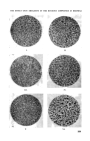
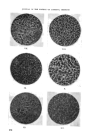
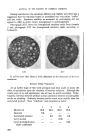
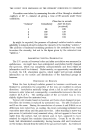
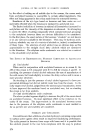
JOURNAL OF THE SOCIETY OF COSMETIC CHEMISTS less viscous than creams A and B at this stage. After a few weeks standing in the capped jars there was, perhaps, little difference in the firmness of creams A, B and E, but cream G was very soft. (c) Surface effect. Examined when cold, creams A and G were the most shiny, followed by B and then E. There was, however, not a great deal of difference between the extremes. (d) Texture. When the surface of the cream was disturbed, cream G had the closest grain, immediately followed by cream A. Cream B came next, with cream E rather more granular. (e) Examined after 3 months standing in screw-capped jars. Cream A still had a shiny surface and did not move round in the jar when stirred (slipping in the container indicates lubrication of the vessel- sides due to free liquid). Cream B had a dull surface and appeared to have lost water and in addition readily slipped round the jar. Cream E had lost water from the surface but did not rotate when stirred. Cream G remained a good, shiny cream but was very soft. (f) Examined after 6 months. Cream A did not appear to have lost water from the surface and had not shrunk in the jar. Cream B had a dull surface, almost transparent, with considerable shrinkage from the sides of the jar. Cream E had suffered considerable water loss and was almost transparent but had not shrunk from the sides. C•eam G remained a good emulsion but very soft. (g) Effect of introducing an oil-soluble dye to creams A and B. Dining the microscopical examination of the creams the effect of adding dyes to both water and oil phase had been studied. Although no useful results were obtained one observation is worth recording. Creams A and B had been made using a soluble red dye in the oil phase. Cream A (coloured) remained stable but cream B (coloured) broke very rapidly. (h) Microscopical examination. The specimens were prepared by spreading the creams as uniformly as possible on the slide and lowering the cover-slip with gentle pressure and without sliding. The magnification in each case was 720 diameters. Three slides of each cream were prepared and each was photographed. The creams examined were A, B, E and G, these being photographed on the same day of making and after three and six months standing in screw-top jars. Photo- graphs I, II, III and IV were taken on the day the creams were made, photographs V, VI, VII and VIII after the creams had stood for three months, and photographs IX, X, XI and XII after six months. Photograph I (cream A) shows a fine state of division, while photograph II (cream B) has a much larger particle size. Photograph III (cream E), which demonstrates the effect of added cetyl alcohol, shows a close packing 268
Purchased for the exclusive use of nofirst nolast (unknown)
From: SCC Media Library & Resource Center (library.scconline.org)