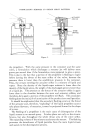
AEROSOL EMULSION SYSTEMS By P. A. SANDERS* Presented December 20, 1957, New York City THE FIRST AEROSOL products and the majority of the aerosol products today were formulated as homogeneous systems in which all of the components of the formulation were mutually soluble. In these products the pressure supplied by the propellent forces the solution of active ingredients, solvents and propellent up the standpipe and through the valve. As the solution leaves the valve the liquefied propellent changes into a gas and blasts the solution of active ingredients into fine particles. There are, however, many materials that would be desirable to spray as aerosols that are soluble in water and have only limited solubility in organic solvents. Water is incompatible with the fluorinated hydrocarbon propellents and the formulation of aqueous-based aerosols giving satis- factory sprays has presented many difficulties. As discussed by Callans (1), the successful formulation of aqueous-based aerosols in the future should lead to a much wider variety of products than are now possil•le with the homogeneous systems alone and should result in a consideraisle expansion of the aerosol market. It is the purpose of this paper to present the various aerosol systems that have been proposed in the attempts to spray aqueous-based products with particular emphasis upon the water-in-oil emulsion systems. THREE-PHASE SYSTEMS One of the first successful methods for spraying aqueous systems resulted from the development of the "three-phase" system by Eaton (2) and Mina (3). In this system, the aqueous solution is layered over the denser fluorinated hydrocarbon propellent, which provides the pressure necessary to force the aqueous phase through the standpipe. The latter extends only into the aqueous phase. Since there is essentially no propellent dissolved in the aqueous phase as it passes through the valve, atomization is obtained by the mechanical shearing action of a special valve rather than by flashing of dissolved propellent. At the present time, such valves produce relatively coarse sprays with these systems. * E. I. du Pont de Nemours and Co., Inc., Freon Products Laboratory, Wilmington, Del. 274

AEROSOL EMULSION SYSTEMS 275 OIL-IN-WATER EMULSIONS Aerosol products formulated as oil-in-water emulsions have been on the market since about 1950. These products are the well-known and widely accepted shaving lathers. In these products, a relatively small amount of propellent, usually about 8 to 10 per cent, is emulsified in an aqueous soap solution. As the emulsion is discharged from the foam valve, the pro- pellent expands, forming countless small bubbles. These give the rich lather characteristic of this type of system. Attempts to obtain fine sprays from such systems by increasing the proportion of propellent and using a spray valve instead of a foam valve result in products which stream. Excessive foaming occurs when the stream impinges on a surface. A series of oil-in-water formulations (4) has been developed that give relatively wet sprays and are essentially non- foaming. These formulations have low concentrations of propellent, usually less than 5 per cent. By the use of auxiliary solvents, such as ethyl alcohol, almost transparent systems are obtained. These systems have the advantage that no creaming occurs during standing and shaking of the formulation before use is not necessary. Window cleaning formulations employing the low propellent oil-in- water system have been marketed for several years and have been well received. These formulations give a soft spray and foam slightly on glass. WATER-IN-OIL E•ULS•ONS During the past several years the Du Pont Company has carried out studies on aqueous-based aerosol systems in an attempt to extend the range of spray characteristics of the water-based aerosol products. This has been found to be possible with the water-in-oil emulsion systems. With such systems, spray properties varying from coarse to very fine may be achieved (5). It was considered initially that the water-in-oil emulsions should have a fairly good chance of producing nonfoaming sprays. In such systems the water is dispersed throughout the propellent. As the emulsion is forced through the spray actuator, the propellent evaporates, leaving the water droplets, the emulsifying agent, and any auxiliary solvents present. Since very little propellent is dissolved in the aqueous droplets, there is less tendency for the vaporizing propellent to cause foam formation with the droplets. Likewise, since the emulsifying agents suitable for water-in-oil emulsions are generally oil soluble, they are usually poor foaming agents for aqueous solutions. In choosing the series of emulsifying agents to study, considerable use was made of the list of synthetic detergents assembled by McCutcheon (6). A wide variety of agents were chosen from this list with the selection
Purchased for the exclusive use of nofirst nolast (unknown)
From: SCC Media Library & Resource Center (library.scconline.org)