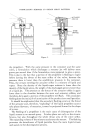
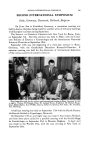
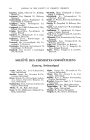
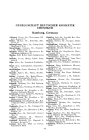
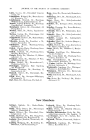
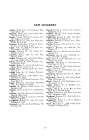
SECOND INTERNATIONAL SYMPOSIUM 309 SECOND INTERNATIONAL SYMPOSIUM Italy, Germany, Denmark, Holland, Belgium Os JusE 2SD in Frankfurt, Germany, a committee meeting was held to discuss the plans being made for another series of technical meetings with European societies during September. The SOCIETY ov COSMETIC CItEMISTS left New York for Rome, Italy, on September 5th. The first seminar was held in Milan with the Comi- taro Italiano di Estetica e Cosmetologia and the Associazione Nazionale Industrie Chimiche on September 10th. September 12th was the beginning of a three-day seminar in Bonn, Germany, with the Gesellschaft Deutscher Kosmetik-Chemiker. A separate meeting was held for the discussion of international federation of the various societies of cosmetic chemists. . :•,. .• • ' ':- a.•'v '"• •1•.. • . ß . •. ß 3:.. . , .. ... •" .:•i . ..:..: ' ?.•. 4 •,-.•' •",• i}% : ... ... .:. Plans being discussed for the seminar and international meeting in Bonn, Germany by (left to right): Thomas H. Prichard, Paris Dr. Gerhard Everts, Frankfurt Dr. Herbert Neuge- bauer, Baden-Baden Kurt Pfeiffer, Geneva Robert A. Kramer, New York Dr. Friedrick Keil, Hamburg. 0 A half-day meeting was held on September 17th with the Dansk Kosme- tik-Kemisk Selskab in Copenhagen, Denmark. On September 19th an overnight stop was made in Amsterdam, Holland, and from there plans called for a possible meeting with the Soci(•t• Belge de Cosm&ologie on September 23rd in Brussels, Belgium. A short visit was made to the World's Fair, with the tour arriving in New York on September 24th.

BOOK REVIEWS DOCUMENTATION IN ACTION, Edited by J. H. Shera, A. Kent and J. W. Perre. Reinhold Publishing Corp., New York 22, N.Y. 1956. 471 pages, size 6 X 9 inches, illustrated and indexed. Price $10. This book is based on the pro- ceedings of the 1956 Western Re- serve Conference "Documentation in Action." It brings together descriptions of systems of documen- tation for use in education, industry or public library. All facets of com- munication as known at the time of presentation are included. In ad- dition areas for future research are included. The book is especially recom- mended to research department libraries. It is a good value and is well printed.--M. G. DENAVARRE. SOLVENT PROPERTIES OF AM- PI-IIPI-IILIC COMPOUNDS, by P. A. Winsor. Butterworths Scientific Publications, London W. C. 2. 1954. 207 pages, size 10 X 6 inches, illustrated and indexed. Price 40s. net. This book a•tempts to give a unified account of the solvent prop- erties of amphiphilic compounds and of related emulsification phe- nomena. These amphiphilic com- pounds are defined as those which possess in the same molecule dis- tinct regions of lipophilic and hy- drophilic character, and thus in- clude not only the typical soaps and detergents but also the hydrotropic salts and[. ?.,the so-called "non- ionic emulsifiers." The approach adopted is of a fundamental nature, with no attempt being made to cover the patent literature or the practical aspects of the subject. The introductory chapter covers such subjects as micelle formation and molecular interactions condi- tioning solubility. The next chapter deals with two component solutions containing amphiphilic compounds. This is followed by a discussion of the general principles involved in solutions of amphiphilic compounds containing water and water-insol- uble organic liquids. Chapter 4 dis- cusses constitutional factors affect- ing the formation of amphiphilic solutions, and chapter 5 the equi- libria in multicomponent systems. Chapter 6 covers solutions contain- ing amphiphilic compounds such as Aerosol OT, ethylene glycol and hydrocarbons not miscible with ethylene glycol. Chapter 7 deals with solubilization of crystalline solids in amphiphilic salt solutions and freezing point depression ef- fects. The last chapter covers x- ray and light scattering measure- ments on detergents solutions and possible interpretations by the au- thor and other investigators. The absence of conceivable mech- anism for explaining water/oil im- miscibility on the basis of repulsion between the different species of molecules leads the author to elim- inate the use of such terms as hy- drophobic, oleophobic and antip- athy. The immiscibility appar- ently arises from the greater com- bined effect of the interactions be- tween molecules of the same species than of those between members of 310
Purchased for the exclusive use of nofirst nolast (unknown)
From: SCC Media Library & Resource Center (library.scconline.org)