PARTICULARITY Oh' HUMAN SKIN 3o7 cells. During wound healing a//of/,he cells around the wound, and not just those of the epidermis are summoned and rushed to the rescue. The cells from the pilary canals, those of the sebaceous glands and those of the outer layer of the sweat ducts glide over the denuded surface and become transformed into epidermal cells, indistinguishable from those derived from epidermal cells. Even the secretory cells of eccrine and apocrine sweat glands, under certain conditions, modulate into totally different cells, ranging from typical epidermal types to mucus secreting cells. Potential sebaceous cells normally show a bimodal pattern of differentia- tion: some synthesize and store lipids, others become keratinized. When disturbances occur, lipid transformation is impeded and most of the cells synthesize keratin. Many other examples could be cited that show that the imprint of specialization is carried lightly by epidermal cells. Under certain conditions the controls that guide the normal path of differentia- tion are probably obliterated, and the epidermal cells, left without control unmask the potential that can be expressed most favorably. There exist profound structural and functional differences between the skin of man and that of most other mammals. In spite of glib statements that the skin of the pig resembles that of man, these are totally different organs. A study of the skin of other primates should give us clues of the evolution of the particular attributes of human skin. For example, whereas most of the sweat glands on the human skin are of the eccrine type, those of other mammals, with rare exception, are apocrine. Even the glands on the body skin of lower primates are apocrine the Pithe- coidea gradually acquire more eccrine glands over their body, and show a concomitant decrease in apocrine glands. In the chimpanzee the number of eccrine glands is greater than that of apocrine glands. A study of the skin of other apes will give us more information about these points. For example, among the other primates, an axillary organ is found only in the higher apes, and attains the greatest development in man, where the glands are numerous and gigantic. The axillary organ, then, is phylogenetically a relatively recent acquisition, and whatever may be its primary biological significance, is a particularity of the skin of man. We are searching for the evolutionary trends that culminated in the establishment of the particular features of human skin. When we have these facts we may have a better insight into the many paradoxes that still confi'ont us in human skin. The academic investigator can afford to study skin with leisure, as he would any other organ of the body. The physician, however, gives di- rection and urgency to these studies. Let the cosmetic chemist capitalize on these findings by compounding substances that make us more attractive, and which are harmless. Armed with fundamental knowledge, he may actually produce cosmetics that may be beneficial to skin.

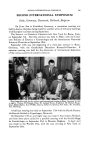
CHICAGO CHAPTER NEWS LERoy W. JEFFRIES, vice-president of the Johnson Publishing Company (Ebony, Hue, yet and Tan magazines) spoke on the subject, "The Potential for Cosmetics in the 17-Billion Dollar Negro Market," May 13. In just eight years Mr. Jeffries has risen from advertising salesman to vice-president of the Johnson Publishing Company. Previous to joining the Johnson organization, he worked as a job analyst and consultant for the Arma Corporation, manufacturers of precision Naval instruments, and he was an industrial relations executive for the National Urban League in New York. He has a B.S. in Economics from Wilberforce College and a M.A. degree in Industrial Relations and Personnel Adminis- tration from Columbia University. Among his professional society affiliations are the National Association of Mark4t Developers and the American Marketing Association. Mr. Jeffries has lectured on industrial relations, personnel adminis- tration and advertising to civic and social organizations and university groups throughout the country. SOCIETY OF COSMETIC CHEMISTS OF GREAT BRITAIN 4'" -•,. .. • . Officers and Council Members 1958-1959 308
Purchased for the exclusive use of nofirst nolast (unknown)
From: SCC Media Library & Resource Center (library.scconline.org)