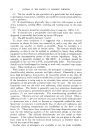
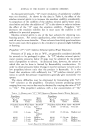
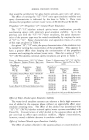
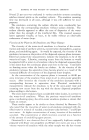
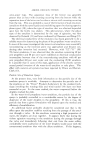
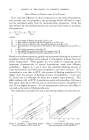
FORMULATING AEROSOLS TO OBTAIN SPRAY PATTERNS 289 (11) Ostwald, Wo., Kolloid-Z., 6, 103 (1910). (12) Cheesman, D. F., and King, A., Trans. Faraday Soc., 34, 594 (1938). (13) Dixon, H. H., and Bennet-Clark, T. A., Nature, 124, 650 (1939) Proc. Roy. Dublin Soc., 19, 422 (1930) Ibid., 20, 211 (1932). (14) Chem. Specialties Mfrs. ,4ssoc. Proc., 43rd /lnn. Meeting, Dec., 1956. (15) Boe, C. F., U.S. Patent No. 2,524,590. (16) Kirk, R. E., and Othmer, O. F., editors "Encyclopedia of Chemical Technology," Vol. 5, New York, Interscience Encyclopedia, Inc. (1950). (17) Propellents referred to in this paper are all the trade name Freons made by E. I. du Pont de Nemours and Co., Inc. HOW TO FORMULATE AEROSOLS TO OBTAIN THE DESIRED SPRAY PATTERN By MARIA V. WIENER* Presented September lB, 1957, New York City THE FORMATION of proper spray patterns often constitutes a prob- lem to aerosol chemists and producers. It is of the utmost importance to formulate each aerosol product with a spray pattern best suited for the intended application. Room deodorants, for example, require very fine atomization in order to keep the active ingredients air-borne for a long time for better effectiveness. On the other hand, the efficiency of colognes does not depend upon an extremely fine particle size as required for room deodorants. Moreover, the colognes require a directed spray, for the purpose of deposition only at the desired spots, and without formation of too small droplets that would not strike the target surface but would be dispersed in the air, and therefore, wasted. THE DRoP SIZE DXSTRIBUT•ON OF SPRAY The spray pattern of an aerosol is best described by the drop size distribu- tion. There are two ways of presentation of drop size distribution in a spray. The one recommended by the Chemical Specialties Manufacturers Association uses the cumulative weight per cent method which records the weight per cent of the spray, with a particle size smaller than or equal to a given diameter (in microns). The mass median diameter is the drop size which divides the spray, so that 50 per cent of it by weight falls below the median diameter and the balance consists of equal or larger particles. Particle size distribution in an aerosol spray often follows the normal logarithmic distribution curve if plotted on a probability graph paper it gives an almost straight line. In Fig. 1, which represents the drop size * Fluid Chemical Co., Inc., Newark, N.J.

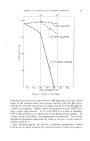
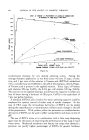
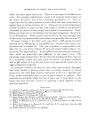
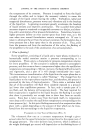
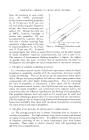
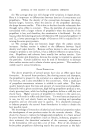
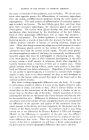
•_90 JOURNAL OF THE SOCIETY OF 'COSMETIC CHEMISTS ! i •.o! i I I I I Figure 1.--Drop size distribution. distribution of an insecticide, the median diameter is 25 microns, the largest particle size is about 65 microns, and only 1 per cent of the total weight will have particles smaller than 5 microns. The second method is presented by the frequency distribution curve, as shown in Fig. 2, for the same product. Here the abscissa is the drop diameter, and the ordinate is the per cent of the total weight of spray which has the corresponding drop diameter. The cumulative weight curve of Fig. I is essentially the integral curve of the frequency plot of Fig. 2, and therefore, knowing one plot the second. can be figured. Here again the particle size of about 2.5 microns constitutes the highest percentage of the spray weight of this particular product. On the cumulative weight per cent graph, a nearly horizontal line repre- sents a more uniform spray. On the frequency plot, a narrow, tall and •ROp DliltF.'l'• - liltlIONS Figure 2.--Frequency distribution of drops. symmetrical curve is obtained with a perfectly uniform spray. T•E S•^PE OF DRoPs The droplets expelled from the orifice have a high velocity near the nozzle they are decelerated by air resistance, and evaporate as they move away from the valve. The particle in its travel through the air
Purchased for the exclusive use of nofirst nolast (unknown)
From: SCC Media Library & Resource Center (library.scconline.org)