FORMULATING AEROSOLS TO OBTAIN SPRAY PATTERNS 291 takes, at first, a teardrop shape, then it becomes round, then elliptical (with the small axis in direction of flow), and finally it assumes a nearly perfect spherical shape until it strikes a surface or evaporates entirely. If any solids are in solution, the shape of the particles will be affected by the process of solidification. In formulations with high solids concentration swift evaporation takes place on the surface of the drop, resulting in the formation of a film, impervious to vapor, which causes ballooning of the drop when the internal vapor causes the film to expand. As a result, hollow particles are obtained. This effect can be observed in some poorly balanced hair sprays and hair lacquers. The size and also the temperature of the liquid drop in the aerosol spray decrease with the distance from the valve, due to evaporation. This is a simultaneous heat and mass transfer process in which heat for evaporation is transferred by convection and conduction from the air and from the liquid itself to the surface of the drop, and vapor is transferred by diffusion and convection into the air from the drop. FACTORS INFLUENCING THE ATOMIZATION OF AN AEROSOL In order to obtain a desired spray pattern for a given product one should be able to evaluate the influence of the following factors on the process of atomization: 1. The design of the valve and the actuator. 2. The pressure in the container. 3. Thermodynamic values--here combined under the term "flashing." 4. Physical and chemical characteristics: surface tension, density, viscosity and solubility. •!. The design of the valve and the actuator The spray distribution is affected by the shape and the size of the valve orifices. A noncircular, irregular orifice will atomize more easily than a round one, but the spray will not be uniform. A perfectly round orifice without any roughness around the edge or without scratches in the throat will give a uniform spray with an equal fraction of delivered quantity of the product in each quadrant of the spray cone. Also the size of drops expelled from a perfectly round orifice will be more uniform, and the average drop size will be larger. The smaller the orifices in the stem and in the actuator of the valve, the finer the spray. Too small orifices however, have a tendency to clog and should be avoided. 2. Pressure in the container The pressure has a significant influence on spray formation. In general, the higher the pressure, the finer the spray pattern and the smaller the spray particles. The pressure within the same container will depend upon

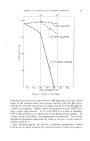
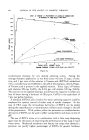
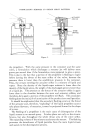
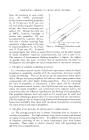
292 JOURNAL OF THE SOCIETY OF COSMETIC CHEMISTS the temperature of its contents. Pressure is required to force the liquid through the orifice and to impart the necessary velocity to cause the collapse of the liquid stream leaving the orifice. Turbulence, radial and tangential disturbances, pressure waves and vibrations aid in the breakup of the liquid jet. A spinning movement greatly accelerates the breakup of liquid streams and improves atomization. The so-called three phase actuators impart a rotational or t'angential movement to the jet, and there- fore, aid in atomization of low pressure formulations. Sometimes, however, higher pressures deliver an even coarser spray than lower ones, as is the case when true aerosol formulations contain entrapped air. If care is taken to eliminate the air from the aerosol container, the formulation has a lower pressure but a finer spray than in the presence of air. Thus, aside from the pressure and from the mechanism of the valve, the flashing of the propellent is the soul of the atomization of an aerosol product. 3. !P'hat is flashing? Every propellent, consisting of a liquid and a vapor phase, enclosed in a hermetically sealed container attains a pressure corresponding to its temperature. There exists a characteristic pressure-temperature relation for every propellent. If the container is suddenly opened to atmospheric pressure, and the contents have a temperature higher than the equilibrium temperature corresponding to 760 mm. mercury, the liquid will boil instantly and vigorously, and a part of it will change immediately into vapor. This instantaneous transformation of the liquid into the vapor phase due to a sudden decrease in pressure is called "flashing." The change from the liquid phase to the vapor phase requires heat, and therefore, this process is governed by the laws of thermodynamics. There exists a mistaken belief that all of the propellent will flash when suddenly exposed to a pressure (p0) lower than equilibrium pressure. In fact, only a certain part of it can flash, and the balance will evaporate slowly. The heat required for flash evaporation is supplied by the liquid because the flashing is so rapid that there is practically not enough time to draw heat from an outside source. Since heat is taken away from the liquid itself, its temperature must drop until it reaches the equilibrium temperature corresponding to the lower pressure (P0). At this point flashing ceases and slow evaporation takes place with a speed depending on the amount of heat which can be trans- ferred from the surroundings to the liquid for evaporation. FLASHING IN THE VALVE ORIFICES (FIG. 3) The volumetric flow rate at a constant temperature through a given aerosol valve for the same formulation is proportional to the square root of the gauge pressure. The valve delivery rate, however, which is defined as the weight discharged per second will depend also on the flashing factor of
Purchased for the exclusive use of nofirst nolast (unknown)
From: SCC Media Library & Resource Center (library.scconline.org)