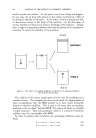
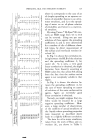
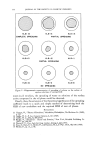
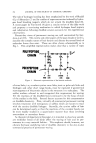
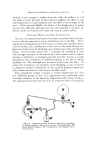
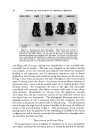
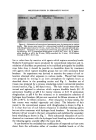
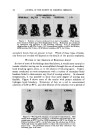
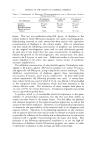
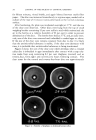
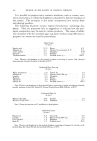
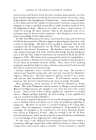
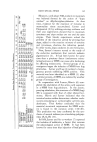
328 JOURNAL OF THE SOCIETY OF COSMETIC CHEMISTS until it reaches the surface. At this point, one of two things will happen. In one case, the oil drop will spread on the surface and become a film of oil, losing its identity as a droplet. In the other, it will not spread and will, in due course, return to the body of the emulsion. In the first case, of course, repetition of the process leads to breaking of the emulsion. Clearly then, a negative spreading coefficient between the phases of the emulsion is necessary to ensure the stability of the emulsion. so UNSTABLE STABLE so Figure 2.--The effect of spreading coefficient on the fate of an emulsion droplet at the emulsion-air interface. The validity of this rather simple point of view may be established in a number of ways. For example, we know, as the result of a large number of years of experience, that the HLB number is, in fact, rather intimately related to emulsion stability. This is true in the sense that an emulsion, made up to the so-called "required HLB" for a given oil phase, is afortiori a stable emulsion. Thus any parameter which is a measure of emulsion stability must be correlatable with HLB. In order to perform this correlation two spreading coefficients were de- fined: al = q/ 8oln. aq. -- (Toil -[- Tint.) $2 = q' •oX•. oi, - (3'•q. + •'i•t.) (Sb)

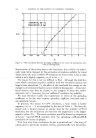
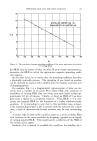
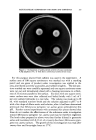
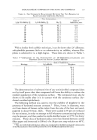
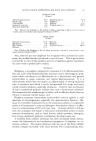
SPREADING, HLB, AND EMULSION STABILITY 329 where St corresponds to the case of an oil droplet spreading on an aqueous so- lution of emulsifier (hence to an oil-in- water emulsion), and S= to the spread- ing of water on an oil-phase solution of emulsifier, and hence to a water-in- oil emulsion. By using Tween © 80-Span © 80 mix- tures an HLB range from 4.3 to 15.0 can be covered. Using one per cent solutions of these agents the spreading coefficients S• and S= were determined for a number of oils of different chem- ical types, by direct measurement of the surface and interfacial tensions in- volved (6). In Fig. 3 is shown the correlation ex- isting between the HLB of the solutions and the spreading coefficient S• for castor oil. As is seen, a very good linear correlation is obtained, the slight deviation from linearity occurring at HLB values less than about 8.0 arising from the fact that the surface active agent is not completely soluble in that region. In Fig. 4 is shown the relation be- tween the spreading coefficient S= for the case of water spreading on castor oil solutions of the same surface active agents. Again an extremely good linear correlation is obtained. Naively, we might suppose that sta- bility would be ensured by a large negative spreading coefficient. How- ever, a large number of observations of the stability of actual emulsions of the liquids whose spreading properties were measured as described above leads to a slightly different conclusion. The data for oil-in-water emulsions, taken from the work of Ross and co- workers (6), are shown in Table 1.
Purchased for the exclusive use of nofirst nolast (unknown)
From: SCC Media Library & Resource Center (library.scconline.org)