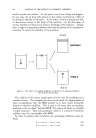
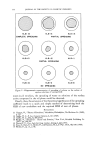
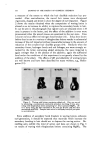
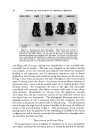
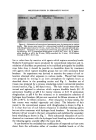
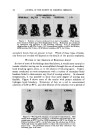
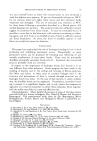
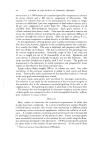
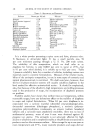
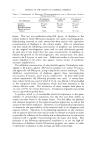
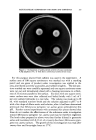
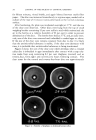
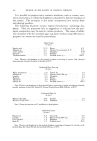
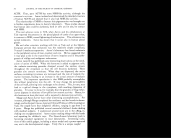
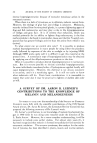
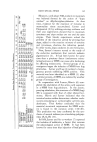
332 JOURNAL OF THE SOCIETY OF COSMETIC CHEMISTS HLB-- 16 HLB=15 COMPLETE SPREADING HLB=14 PARTIAL SPREADING HLB=13 HLB= 12 HLB-- II PARTIAL SPREADING HLB= I0 HLB= 9 HLB= 8 NO SPREADING Figure 5.--Diagrammatic representation of spreading of toluene on the surface of aqueous solutions of varying HLB. water-in-oil emulsion, the spreading of water on solutions of the surface active compound in the oil phase could be observed. Clearly, then, the extension of the theoretical significance of the spreading coefficient leads to a quick and simple method of determining both the HLB of new emulsifiers and the required HLB of new oil phases. REFERENCES (1) Clayton, W., "Theory of Emulsions," 4th edition, Philadelphia, The Blakiston Co. (1943), p. 127. (2) Griffin, W. C., ]. Soc. Cosmetic Chemists, 1, 311 (1949). (3) Griffin, W. C., Ibid., 5, 249 (1954). (4) Becher, P., "Emulsions: Theory and Practice," New York, Reinhold Publishing Co. (1957), pp. 188-205. (5) Davies, J. T., Proc. 2rid. Intl. Cong. Surface ./lctivity, I, 426 (1957). (6) Ross, S., Chen, E. S., Becher, P., and Ranauto, H. J.• ]. Phys. Chem., 63, 1681 (1959). (7) Becher, P., op. cit., p. 86.

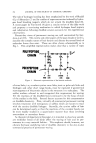
MOLECULAR FORCES IN PERMANENT WAVING By HERMAN BOGAT¾* Presented May 12, 1960, New York City THE PERMANENT WAVING industry has continued to grow since the advent of the cold waving process some twenty-five years ago so that today and every day this year, an average of roughly one-quarter million women will wave their hair and will spend 11/a million dollars in the process. As a consequence of its increasing economic importance, many innovations and improvements have accompanied the development of the industry, and a number of these have contributed to the growth in the patent litera- ture. Contributions to the basic scientific understanding of hair and hair waving have been fewer. This is due not only to the relatively few labora- tories that have done fundamental work in this field, but the inherent com- plexities are very great requiring the utilization of insights from the diverse scientific disciplines of chemistry, physics and biology. While initially ideas were borrowed from the field of wool chemistry, there is at least by now the beginning of a more mature scientific knowledge of hair and hair waving which can stand by itself. As time goes on, however, new thinking and ideas will be desired and needed by the industry for further progress to be made. Relevant to the present paper is the extensive research that has been done on the phenomena of set and "supercontraction" in wool. This has concerned itself with the observations of the changes in the length of wool fibers exposed in various ways to steam, to boiling water, to many other reagents and to the effects of chemical modification of the wool on these changes. These studies have produced a large body of literature with some differences in viewpoint among the workers in the field. Without attempting a detailed review, it may be sufficient to note that Speakman, his co-workers (1, 2, 3) and Phillips (4) initially emphasized the formation of new types of covalent cross links from the keratin disulfide in setting reactions. Some objection to the mechanisms proposed arose from the work of Blackburn and Lindley (5), and these authors suggested that secondary forces could also play a part in setting and in supercontraction. * The Toni Company, Chicago 54, Ill. 333
Purchased for the exclusive use of nofirst nolast (unknown)
From: SCC Media Library & Resource Center (library.scconline.org)