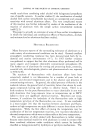
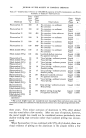
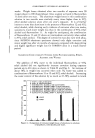
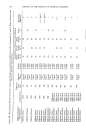
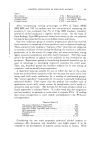
324 JOURNAL OF THE SOCIETY OF COSMETIC CHEMISTS RETARDATION STUDIES WITH VARIOUS ORGANIC CHEMICALS IN MIXTURES OF FLUOROCARBONS, ETHYL ALCOHOL AND WATER Organic additives listed in Table IV seem to be less effective retarders as a group than the inorganic salts of Table Ill. A number of organic halogenated hydrocarbon stabilizers and retarding agents for the reaction between aluminum and carbon tetrachloride were employed without success. Propylene oxide added in 0.2% concentration was the only organic additive which seemed to retard the corrosion process. In most cases the aluminum weight losses were higher with these organic additives than without them. This observation suggests that the addition of small concentrations of organic chemicals in various aerosol formulations should be screened against the possibility of causing higher corrosion rates than those established for the formulation without the additive. STUDIES OF THE EFFECT or THE SUBSTITUTION OF OTHER ALCOHOLS OR ORGANIC SOLVENTS FOR ETHYL ALCOHOLS IN MIXTURES WITH FLUOROCARBONS The rather startling observation is readily made in Table V that many other higher homologue alcohols do not create this same corrosion hazard with aluminum in the presence of fluorocarbons. Isopropyl alcohol with fluorocarbons appeared to be completely innocuous, and confirmation was obtained in two separate tests of 767 and 1022 days, respectively. N-propyl alcohol and n-butyl alcohol were also without significant effects for 767 and 1022 days, respectively. Solutions of the higher alcohols (iso and n-amyl alcohols) with fiuorocarbons were free of any corrosion for periods of almost two years, and in one test with isoamyl no corrosion appeared in almost a three year exposure. In any case, it appears that the use of any of these higher alcohols in place of ethyl alcohol offers freedom from corrosion for periods in excess of the longest projected shelf- life of most aerosol products. It might be admitted that the water content of the various c.p. grade alcohols was different. We do not believe that this explains the difference in behavior of various alcohols because of Giggard's report (14) that no water concentration could be found which significantly reduced the amount of corrosion using ethyl alcohol. Acetone or ethyl acetate were also included in other tests as possible solvents for organic aerosol additives, and they showed no corrosion tendencies in a test period of two years.

COMPATIBILITY STUDIES OF ALUMINUM 325 CONCLUSIONS 1. Fluorocarbons 11 or 12 or 95o-/o ethyl alcohol separately have only a minor corrosive effect on aluminum after 414 days of exposure. 2. Combinations of fluorocarbon 11 or 12 and 95% ethyl alcohol have a corrosive effect on aluminum which is apparent within a few weeks. Weight losses within 60 days are as much as ten times higher than those for the separate chemical exposures after 414 days. 3. Addition of fluorocarbon 12 to fluorocarbon 11 reduces the corrosive effect on aluminum of the latter when combined with 95% ethyl alcohol. 4. Additions of 10% water to fluorocarbon 11 or 12, or to 95% ethyl al- cohol did not further accelerate or retard any initial corrosive tendencies. Additions of 5% water increased the corrosivity of fluorocarbon-ethyl alcohol solutions. Water additions of 25 to 50% initially retarded cor- rosion, then accelerated it. 5. Only six out of 32 tested combinations of inorganic and organic chemicals were shown to retard corrosive effects on aluminum when added to fluorocarbon and ethyl alcohol mixtures. 6. Seven higher homologue alcohols and two aromatic alcohols did not show corrosivity patterns when combined with fluorocarbon 11 for periods of time up to three years. Ethyl acetate and acetone, common representatives of the ester and ketone families, similarly exerted no effect on aluminum. 7. The corrosive effect on certain aluminum alloys of alcohol-.fluoro- carbon solutions appears to be a problem only when the one or two carbon chain alcohols are employed. /lcknowledgment. The author would like to express his appreciation to Mr. R. J. Stimel for his technical assistance. (Received September 30, 1963) REFERENCES (1) Unpublished data from the Alcoa Research Laboratories. (2) J. D. Minford, M. H. Brown, and R. H. Brown, J. Electrochem. $oc., 106, 185 (1959). (3) R. H. Brown, E. H. Cook, M. H. Brown, and J. D. Minford, Ibid., 106, 192 (1959). (4) C. J. Walton, D. O. Sprowls, and J. A. Nock, Jr., Corrosion, 9, 345 (1953). (5) C.J. Walton and W. King, Symposium on •ttmospheric Corrosion of Non-Ferrous Metals, Special Technical Bulletin No. 175, ASTM (1955). (6) R. B. Mears and R. H. Brown, Soc. Naval •trchitects Marine Engrs., Trans., 52, 91 (1944). (7) C. J. Walton and E. T. Englehart, Presented before Soc. Naval Architects & Marine Engrs., (Chesapeake Sect.) Nov. (1949). (8) W. W. Binger, R. H. Wagner, and R. H. Brown, Corrosion, 9, 440 (1953). (9) E. D. Verink and E. P. White, The Petroleum Transporter, Sept.-Oct. (1956). (10) J. D. Minford and T. S. Humphries, Ind. & Eng. Chem., 48, 1975 (1957). (11) B. J. Eiseman, •tm. $oc. Heating Re/rig. •tir Conditioning Engrs. J., 5, 63 (1963). (12) P. A. Sanders, Soap Chem. Specialties, 36, 95-103 & 173 (1960). (13) R. M. Howe and F. M. Lanquedoc, Ibid., 37, 79-87, 163-165 (1961). (14) E. D. Giggard, •terosol •tge, 6, 20 (1961).
Purchased for the exclusive use of nofirst nolast (unknown)
From: SCC Media Library & Resource Center (library.scconline.org)