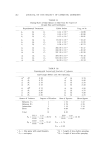
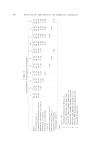
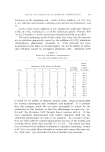
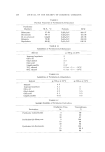
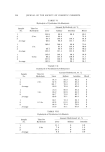
332 JOURNAL OF THE SOCIETY OF COSMETIC CHEMISTS The most significant anti-irritant effect was noted when both Tween 20 and Myvacet 940 were present in the antiperspirant spray (Formula H). The seventy-two-hour eye irritation scores for this formula averaged only one-fifth those of the control, Formula B. Additions of Pluronic F68 (Formula J) or aluminum chlorhydroxy allantoinate (For- mula K), seemed to nullify some of the anti-irritant effects produced by the Tween-Myvacet combination. The primary skin irritation test results for this series were not interesting at all. Draize (12) defines topical preparations as "mildly irritating" if they show a primary irritation (PI) index no higher than 2.0. The control product for primary skin irritation Formula A, was applied to each rabbit simultaneously with the various test products. It gave PI indices which varied from 0 to 0.25 the test formulation PI indices varied from 0 to 0.44. In order to try to visualize primary irritations more clearly, Trypan Blue injections were attempted. Since none of the formulations was a primary irritant (when applied according to the techniques of Draize), all of these attempts to deter- mine possible topical anti-irritant effects were useless. CONCLUSIONS Some will question the validity of the test results reported in this paper, saying that the irritation tests themselves are not valid because of inability to reproduce them exactly. The eye is too sensitive and too variable an organ to react consistently when subjected to the type of insult called "the eye irritation test" (see Table V). In contrast, the skin's role of acting as a protective layer for the body means that it is inherently resistant to insults by various foreign matehals. As a result, irritation test results sometimes vary wildly and at other times show almost nothing at all. This is unfortunate, but nevertheless the fact remains that some products are irritating to the body, and some are not. Crude as they are, no one should doubt that animal irritation tests of this sort are worth carrying out. Even "average" results are better than no indica- tion at all, and such averages in fact are sufficiently reliable to rank a series of products to determine their order of irritation potential to humans. We will not know the exact extent of the irritancy or anti-irritant usefulness of various matedhals until we have developed more refined irritation testing procedures. In the meantime, we must work with what is available to us. The available evidence points very strongly to

USE OF ANTI-IRRITANTS IN COSMETIC FORMULATING 333 the conclusion that certain materials can act as potent anti-irritants for others. Furthermore, ingredients may change roles, varying from ir- ritant to "safe" to anti-irritant, depending on what other materials are used in conjunction with them in a formulation. No material should ever be considered absolutely safe or absolutely unsafe for application to the human body. Safety data on individual ingredients are very useful (giving an indication of problems which may arise), but no formulator should depend solely on so-called positive and negative lists of permitted or forbidden ingredients. Someone once said, "Wisdom would be easy if we only had to choose between the black and the white." Unfortunately, the cosmetic for- mulator is rarely offered a clear-cut choice in trying to decide whether a particular product will be "safe" when used by the general public. The cosmetic formulator must do the best he can with test data of the sort currently available to him, resulting from applying the .finished product in the manner intended for use by the ultimate consumer. This gives him the greatest possible flexibility and allows the use of any ingredients he chooses, so long as he can show that the final product is not inju- rious. APPENDIX Following is a list of two dozen cosmetic ingredients for which reasonably credible anti-irritant claims have been made. Reference to the original published data is strongly recommended to those interested in using these products as anti-irritants. Not all of the claims have been rigorously substantiated. Regardless, confirmatory irritation testing should always be carried out on finished formulations even though they contain materials previously shown to possess anti-irritant properties. Inclusion in this list does not constitute general endorsement. In- stead, it is hoped to bring these materials, and the claims made for them, to the attention of cosmetic chemists for further investigation of possible anti-irritant activity. Aloe Vera Several references (17, 18) claim remarkable curative and detoxifying powers (topical and internal) for the hexosan gel and other polyuronide extracts of thi. s cactus. They also claim topical anesthetic effects and (17, 19) promotion of healing (granulation) of damaged tissue. No published data are available proving anti-irritant activity in controlled tests.
Purchased for the exclusive use of nofirst nolast (unknown)
From: SCC Media Library & Resource Center (library.scconline.org)