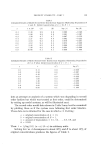
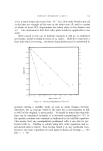
142 JOURNAL OF THE SOCIETY OF COSMETIC CHEMISTS The role of temperature, which is the foundation upon which almost all of the accelerated stability testing procedures rest, can be brought into play by plotting the too values obtained from data taken at various temperatures vs. 1/T to get an Arrhenius-like plot but with a positive slope. The point at which the line crosses the abscissa representing room temperature is the length of time it would take the material to break down to 90% of its original concentration. Obviously, the time to reach any other desired degree of breakdown could be sought by a procedure analogous to that just described for the determination of too. One final point involves the question of whether reactions at higher temperatures really reflect what will happen at room temperature. Obviously, higher temperatures may not if they destroy the fundamental nature of the formulation. Unfortunately, the question is not an easy one to answer conclusively. Some insight into the validity of high tem- perature stability studies may be gained, however, by consideration of some data already published. Examples from the literature will be used to examine some kinetic data taken at widely different temperatures. As will be seen, the same kinetic expressions for the degradation of thiamine hydrochloride appear to be valid over a very wide temperature range this is not so, however, in the cases of the degradation of glucose in acid solution or of aqueous procaine hydrochloride solutions. Stability studies which utilize quite high temperatures are always suspect because the question always arises: Are the same or different degradative reactions predominant at these higher temperatures as at lower temperatures? The literature contains information which illu- strates that, in the case of aqueous solutions of thiamine, the same reac- tions appear to predominate both at room temperature and at 140øC. However, no one seems to have studied this point explidtly. For ex- ample, Farrer (1-4) in his fairly extensive researches on the thermal de- struction of Vitamin B• has never related his data obtained at 100 øC to what might be happening at 25øC. Obviously, the answer to our im- plied question is of the utmost importance when one is considering a study of the stability of B• in pharmaceutical formulations. Although thiamine could not arbitrarily be declared a "typical" drug, it is a rather complex molecule which can (with appropriate reagents) degrade in several ways, just as many other compounds may. On this basis then, it is interesting to see the results of some calculations using data in the literature. Macek, Feller, and Hanus ($) studied the degradation of aqueous solu- tions of thiamine mononitrate. The pH's were adjusted to 4 with HC1

PRODUCT STABILITY--PART I 143 so that the ionic species resulting were essentially the same as in the Watanabe study mentioned below the samples were stored at room temperature and 40 øC for varying periods of time up to one year. These workers did not calculate either kinetic specific reaction rate constants or the heat of activation of the degradative reaction. However, using their 1, 6, and 12 month data, approximate values can be calculated: 25øC: k = 4.80 X 10 -a mo. -1 4()øC: k = 4.05 X 10 -2 mo. -• This situation corresponds to a heat of activation of 29,000 cal./mole. Watanabe (6, 7) carried out similar studies at temperatures of 100, 110, 120, 130, and 140øC. For his study done at pH 4.2 he lists these spe- cific reaction rate constants: 100øC: k = 2.7 X 10 -2 hr. -• 110øC: k -- 6.9 X 10 -2 hr. -• This situation corresponds to a heat of activation of 26,100 cal./mole Watanabe, on the basis of all his data, lists the value of the Alia as 31,000 cal./mole. It may be concluded that the agreement between the two different groups' value for the heat of activation is very good. Of course, this alone does not indicate conclusively that the degradative reaction at 25 and 110øC is the same, because the possibility of a family of lines existing on an Arrhenius plot must not be overlooked even though the slopes of the lines might be the same. However, even with the conver- sion factor 720 hours = 1 month, the data from the different tempera- tures do form a single linear Arrhenius plot. Considering the different investigators, the variability of the assay method for thiamine, and the approximation of time values in the year-long study, agreement between the two studies is surprisingly good. The data indicate that the same kinetic situation predominates both at very high and at low tempera- tures. This then is one case which can be considered neither completely typical nor completely atypical but in which studies at high tempera- tures prove to be significant. It is easy for anyone who has studied the kinetics of relatively com- plex pharmaceutical formulations to cite examples wherein the results of high and low temperature studies do not present such a tidy picture as in the thiamine case just discussed. It is possible also to cite exam- ples which concern systems with only one degrading ingredient to illu- strate such situations. Heimlich and Martin (8) in a detailed study of the degradation of glucose in acid solution have shown that a change in
Purchased for the exclusive use of nofirst nolast (unknown)
From: SCC Media Library & Resource Center (library.scconline.org)