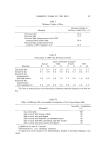
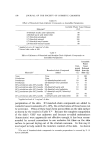
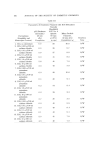
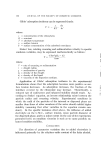
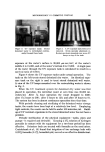
158 JOURNAL OF THE SOCIETY OF COSMETIC CHEMISTS Table IV Effect of Branched-Chain Aliphatic Compounds on Insensible Perspiration Invisible Water Vapor Release Materials a ( %)b 10-Methyl stearic acid triglyceride 4-Methyl laurie acid triglyceride 2,7-Dimethyl-octadienol 2,7- Dimethyl-octanol 2,7-Dimethyl-octyl laurate 2,6-Dimethyl-octenyl laurate 98 99 100 100 99 98 Applied at rate of 1 mg/cm • of skin. Normal skin value is 100. Table V Effect of Mixtures of Branched and Straight-Chain Aliphatic Compounds on Insensible Perspiration Branched-chain Compound Materials a Added Insensible Water Corn- Vapor pound Released Added from the (%) Skin (%) None None 0 100 Petrolatum None 0 38 Petrolatum 3,5-dimethylmyristic acid 10 62 Petrolatum 2,6-dimethyl-octyl palmitate 10 71 50% petrolatum plus 50% lanolin None 0 62 50% petrolatum plus 50% lanolin 2,6-dimethyl-laurie acid 10 84 50% petrolatum plus 50% lanolin 2,6 dimethyl-octyl palmitate 10 82 50% petrolatum plus 50% lanolin 3,7-dimethyl-octyl-3,7-dimethyl ottoate 10 84 50% petrolatum plus 50% lanolin 4-methyl-laurie acid triglyceride 25 94 a Applied at level of 1 mg/cm • of skin. perspiration of the skin. If branched-chain compounds are added to cosmetic bases in amounts of 5-10%, the ocdusiveness of these bases can be overcome. Films of these bases form porous films on the skin surface as shown by the results in Table V.* Because the complete composition of the skin's NMF was unknown and because so-called moisturizers (humectants) were apparently not effective enough, it has been recom- mended by several researchers to use occlusive fat films on the skin surface to prevent drying out of the stratum corneum. In this way it was hoped to help control the moisture content of the skin. As shown * The use of branched-chain compounds in cosmetic preparations is covered by U. S. Patent 3,035,987.

COSMETIC FILMS ON THE SKIN 159 in the foregoing experiments, human sebum forms a porous film on the skin surface. This porous film of sebum allows the skin to exchange moisture, carbon dioxide, and oxygen with the environment. Conse- quently the use of occlusive films as cosmetic products on the surface of the skin to prevent moisture loss appears to be a nonphysiological treatment because it potentially interferes with natural functions of the skin. In spite of its porosity, the sebum film serves as a protective cover for the skin. It protects the skin, among other things, against removal from the skin of NMF by excessive contact with water during swimming or bathing. The experimental results presented here strongly suggest that'syn- thetic NMF (based on the analysis of natural NMF) may be considered an effective moisture control. Since effective moisture regulation of the epidermis through use of a synthetic NMF seems feasible, the question of applying occlusive films to the skin surface appears less desirable. SUMMARY It has been shown that the natural moisturizing factor of the human skin can be duplicated synthetically. Experiments have shown that this synthetic NMF is as effective as the natural moisturizing factor of the human skin. The use of synthetic NMF makes unnecessary use of occlusive films on the skin surface to prevent moisture loss. It has been shown that the human sebum forms porous films on the skin surface and that this property depends on the content of branched- chain compounds in human sebum. The addition of aliphatic branched- chain compounds to cosmetic bases makes possible formulation of prod- ucts forming porous films similar to those of human sebum on the skin. (Received August 8, 1966) REFERENCES (1) Jacobi, 0., Kolloid Z., 114, 2 (1949). (2) Schneider, W., and Schuleit, H., Arch. Dermatol. Syphilol., 195,434 (1951). (3) Blank, J. H., J. Invest. Dermatol., 18, 6 (1952). (4) Spiel H. W., and Pascher, G., Hautarzt, 7, 2 (1956) Acta Dermato-Venereol. Proc., 2, 14 (1957). (5) Szakall, A., and Stripel, H., Die W•rkung yon Waschmitteln auf die Haut, Hfithig He_ide[- berg, 1957. (6) Flesch, P., J. Invest. Dermatol., 1,63 (1958). (7) Flesch, P., and Esoda, E. C. Jackson, J. Invest. Dermatol., 28, 5 (1957), (8) Gartmann, H., Deut. Med. Wochenschrift, 83, 9 (1958).
Purchased for the exclusive use of nofirst nolast (unknown)
From: SCC Media Library & Resource Center (library.scconline.org)