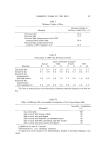
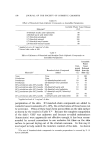
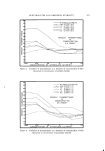
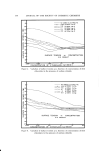
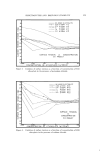
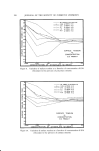
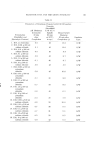
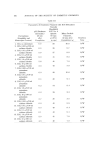
166 JOURNAL OF THE SOCIETY OF COSMETIC CHEMISTS •)ISCUSSION AND CONCLUSIONS The nature of the experimental setup (the examination of the inci- dence and severity of diaper rash during a four week period immediately following a time when all symptoms were absent and its comparison with a previous score reflecting the most severe episode in the past) accounts for the improvement noted with "time" and "soap" (both kinds) and their highly statistical significance. Of practical and paramount impor- tance in the present study is the high statistical significance of the "change with Soap A vs. change with Soap B" for the categories: Erythema, scaly dermatitis, and diameter of the rash. The lower occurrence of statistically significant results for the more serious categories (and, in particular, the absence of a significant differ- ence between the two soaps) reflects the paucity of data in these cate- gories due to the very low incidence of these symptoms. The finding in this study of a highly significant age and sex depend- ence of incidence and severity of diaper dermatitis corroborates pre- viously reported results. SummARY The severity and incidence of diaper dermatitis during the use of germicidal commercial soap (A) was investigated over a period of 28 days and compared with those during the use of a nonmedicated soap. For the relatively common varieties of diaper dermatitis symptoms (erythema and scaly dermatitis) and the over-all diameter of the rash there was a significant reduction in the average severity and incidence when Soap A was used. For the less common and more serious varieties of symptoms (eczema- toid dermatitis, ulcerative dermatitis, and vesicular dermatitis) the reduction in average severity and incidence by the medicated soap was not significantly different from the comparable reduction with ordinary soap. The average severity and incidence of all varieties of diaper derma- titis is significantly higher in males than in females and, among both males and females, among the older (9 months and over) infants. (Received September 20, 1966) BIBLIOGRAPHY (1) Dubow, E., Ammoniacal dermatitis in infants, Arch. Pediat., 71,323-20 (1054). (2) Fijan, K. J., Jolliff, C. R., and Engelhard, W. E., Treatment of diaper rash with an aerosol product, Clin. Med., 71, 1335-42 (1004).

BACTERIOSTATIC SOAP 167 (3) (4) (5) (6) (7) (8) (9) (10) (11) (12) (13) (14) (15) (16) Kaessler, H. W., Dermatitis of the diaper region--A new remedy for an old affliction, Arch. Pediat., ?4, 47-50 (1957). Benson, R. A., Lawrence, C. A., and Chavkin, L., Commercially and home-laundered diapers. A comparative evaluation of their role in the cause and prevention of diaper dermatoses, Arch. P ediat., ?3,250-58 (1956). Greene, M., and Rich•nond, J. B., Pediatric Diagnosis, W. B. Saunders Co., 1962, p. 206. Periman, H. H., Current Pediatric Therapy, W. B. Saunders Co., 1966, p. 579-81. Lipschutz, A., and Agerty, H., Prophylaxis in pediatric skin care, Arch. Pediat., ?9, 257 (1962). Clyman, S., Resistant diaper area dermatoses: A new therapeutic approach, Skin, 3, 86-7 (1964). Seneca, H., et al., Bacterial urease in pathogenic bacteria, Arch. Pathol., 74, No. 6, 489-94 (1962). Editorial, Diaper rash, J. Am. Med. Assoc., 165,254-5 (1957). Lipschutz, A., and Fitti, R. M., New antibacterial detergent for common skin diseases in children: Use in prophylaxis and treatment, Arch. Dermatol., 68, 83-85 (1953). Kahan, H., et al., A new remedy for the prevention and management of napkin derma- titis, Arch. Pediat., 73,125-9 (1956). Thompson, D. J., et al., Sex distribution of Staphylococcus aureus colonization and dis- ease in newborn infants, New Engl. J. Med., 269,337-41 (1963). Burgoon, C. F., et al., Diaper Dermatitis, in Symposium on Pediatric Dermatology, Pediatric Clinic of North America, 8, No. 3,835-56 (1956). Batsoon, H. C., An Introduction to Statistics in the Medical Sciences, Burgess Publishing Company, Minneapolis, Minn., 1956. Scheffe, Henry, The Analysis of Variance, Wiley, New York, 1959.
Purchased for the exclusive use of nofirst nolast (unknown)
From: SCC Media Library & Resource Center (library.scconline.org)