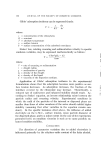
J. Soc. Cosmetic Chemists, 18, 169-189 (Mar. 4, 1967) The Relationship Between Effects Due to Electrolytes Emulsion Stability Surface and AARON MILLER, B.S.* Presented May 10, 1966, New York City Synopsis.--It is shown that the addition of dectrolytes to emulsions can alter specific pa- rameters which, in turn, can be related to emulsion stability. A mechanism for the action of specific electrolytes on emulsion systems containing certain nonionic polyoxyethylene ethers as emulsifiers is postulated. The surface chemistry effects which result from the included salts are discussed. INTRODUCTION The cosmetic chemist may often be required to formulate an emulsion containing an electrolyte. A wide variety of suitable emulsi- fiers is available for this purpose. However, the presence of electrolytes, even in small quantities, will often cause changes in the surface chemistry of commonly employed emulsifiers and seriously affect the stability of the product. The difficulties created by the inclusion of electrolytes may be elusive. A nonionic emulsifier, e.g., an ethylene oxide condensate, is often selected to overcome the formulation problems which may arise due to the presence of electrolyte. However, this approach, too, must be carefully considered. Although the literature concerning the effect of electrolytes on emulsifiers is extensive, the investigators generally * Kolar Laboratories, Inc., 1123 W. Jackson Blvd., Chicago, Ill. 60607. 169

170 JOURNAL OF THE SOCIETY OF COSMETIC CHEMISTS were concerned more with electrolyte-emulsifier interactions rather than their effect on the emulsion system (1-3). In this paper it will be shown that, in formulations containing cer- tain nonionic ethoxylates, emulsion stability may be enhanced or diminished by the addition of specific quantities of various electrolytes. From a study of variations of surface-related measurements of several polyoxyethylene ethers by added electrolytes, a mechanism of electrolyte emulsion interactions may be postulated. EXPERIMENTAL The surface-active •aterials used in the formulations were a series of ethoxylated fatty alcohols. The Siponics•, * in which the series number is multiplied by 2 to obtain the degree of ethoxylation, were used. The exceptions to this rule are Siponic EO and Siponol TX•* the former contains one molecule of ethylene oxide and the latter none. The ethylene oxide content of the emulsifiers used in the experimental formulations ranged from 10 to 30 molecules per fatty alcohol molecule. The ethoxylates were the sole emulsifiers used in all formulations. All added electrolytes were reagent grade. Preparation of Emulsions The formulations were made by combining two emulsion phases. The electrolytes were placed in the aqueous phase, while mineral oil (65/75 Saybolt) and ethoxylate were considered to be the oil phase. This procedure was used because, in a preliminary series, conductivity and dispersibility measurements indicated that the particular ethoxy- lates chosen formed O/W emulsions. It was also ascertained that emulsion stability was somewhat enhanced when the ethoxylate was included in the oil phase. All the electrolytes were water-soluble. The two emulsion phases were placed separately in two 1500 ml Pyrex beakers and heated in a hot water bath to 80 q- 1 øC. The water phase was then added to the oil phase slowly in a thin stream. A four-blade propeller, which was inserted to a depth of 3.8 cm below the emulsion surface, was used for agitation. The propeller speed was kept constant at 100 rpm. The product was formulated in an air-conditioned labora- tory at 25 q- 1 øC and 40 q- 5% relative humidity. Continuous agita- tion was maintained during air cooling. The experimental emulsions were designed so that at completion each weighed 1000 g. Aliquots of ß Siponic and Siponol are registered trade names of Alcolac Chemical Corp., Baltimore, Md. 21226
Purchased for the exclusive use of nofirst nolast (unknown)
From: SCC Media Library & Resource Center (library.scconline.org)