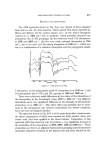
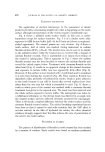
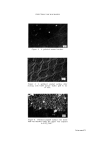
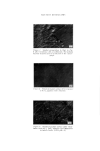
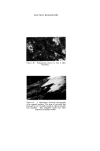
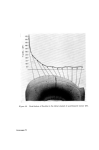
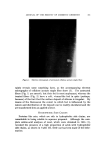
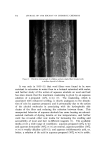
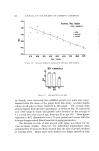
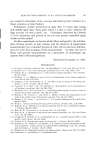
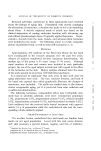
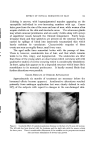
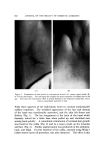
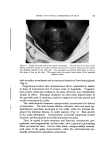
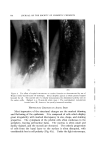
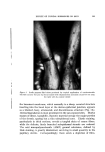
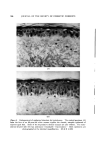
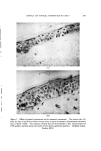
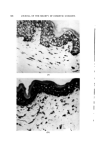
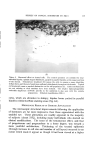
JOURNAL OF THE SOCIETY OF COSMETIC CHEMISTS magnification than its control specimen. Regularity in cell size and shape was restored, nuclear and cytoplasmic content seemed plumper, and nucleoli became distinct. Stratification of cells throughout the epidermis was restored to the normal pattern (Fig. 6B). The basement membrane thickened perceptibly, stained more vividly, and became sharply defined and unbroken (Fig. 7B). The dermis showed increased AMP staining of deeper hue and broader distribution. There was an accompanying alteration in the morphology of the fibrocytes, which resumed a plump stellate form and were found dispersed throughout the dermis (Fig. 8B). The heavy material of basophilic degeneration appeared diluted or washed out by the increased AMP. In a similar fashion, the coarse tangles of elastic tissue appeared more separated and were pushed further away from the papillary dermis. This subepidermal zone now contained numerous fine elastic fibers which ran perpendicularly to the dermo-epidermal junction. Estrogen-treated tissues could not be distinguished from the con- trols. As with the clinical results, the corticosteroids produced degrada- tive changes easily seen by microscopic examination. The epidermis became uniformly atrophic and was often reduced to a structure of only several cell layers' depth. The basement membrane suffered further washout and became more indistinct. Dedmation of the cell popula- tion of the dermis (Fig. 8C) was accompanied by diminished AMP staining. The subepidermal orcein staining fibers were little changed following corticosteroid treatment. DISCUSSION These studies indicate that topically applied steroid hormones can produce definite alterations in aging human skin. Androgens primarily tend to ameliorate the degradative changes, while the corticosteroids further exaggerate the deterioration. Exactly how these modifications develop is not yet known, and perhaps study of the mechanisms may provide insight into the aging process itself. Cutaneous senescence at least appears to have been conveniently bracketed by this divergent action of structurally related chemicals. One fact which is clear is that the observed results are entirely local. Similar effects on distant or neighboring untreated skin do not occur. Systemic administration of the hormones in therapeutic amounts over an extended time are also ineffective (3). Of all the steroids used, only the estrogen showed significant absorption as such, with general effects

EFFECT OF TOPICAL HORMONES ON SKIN 561 such as gynecomastia in men and resumption of uterine bleeding in postmenopausal women. Apparently the application of pharmacologic quantities of hormones to the skin yields unique results which cannot be predicted from know- ledge of their usual physiologic and systemic effects. It is becoming evident that cutaneous pathways of metabolism for steroids exist and that much remains to be learned of their integumentary fate (4-8). It is clear, however, that hasty generalizations drawn from "expected results" can be misleading. The reliance on topically applied female hormones to alleviate the defects of aging skin undoubtedly draws support from this type of reasoning. With regard to the practical implications of our studies, it is of course most encouraging to have achieved even these modest changes on skin which was already markedly damaged. This strongly suggests that prophylaxis might well yield even more satisfactory results. It is conceivable that application of the appropriate steroid begun rather early in life, particularly in light skinned, susceptible individuals, might not only enhance their appearance in later years but also afford protec- tion against the development of cutaneous epitheliomas. SUMMARY The characteristic structural changes which typify aged skin, both in protected and actinically damaged areas, can be modified by the topical application of steroidal hormones. Androgenic compounds exert an ameliorative effect, restoring the gross and microscopic archi- tecture toward a more youthful integument. Hair growth is stimulated, sweat secretion increased and, in some instances, the sagging and fine wrinkling of senescence effaced. The microscopic improvement is even more uniform and striking, particularly in the epidermis where the dis- orderly cytologic and histologic alterations are reversed. The "benefi- cial" effects of topical estrogen have not been confirmed, and such substances exert no appreciable activity on human skin. Corticosteroid action is diametrically opposite to that of the androgens, and topical administration accentuates the degradative changes. ACKNOWLEDGMENT Particular appreciation is acknowledged to the administration (Raymond S. Groller, Director) and the residents of Riverview Home for the Aged who participated in this study. (Received November 14, 1966)
Purchased for the exclusive use of nofirst nolast (unknown)
From: SCC Media Library & Resource Center (library.scconline.org)