THE EVALUATION OF PLACEBOS IN CLINICAL TRIALS 457 response is quantitative we may suppose that pharmacological factors predominate although this is not always the case since, for example, Wolf et al (5) found it possible to affect the eosinophile count by placebo action. Such quantitative observations would occur, for example, in a thai to test the effects of treatments by various fruit preparations on the vitamin C content of the blood. These effects can only be measured against a stan- dard which in this case consists of the absence of treatment. However those persons receiving the fruit preparations are thereby also receiving extra water, sugar and other components besides vitamin C so that the absence of treatment should be interpreted as receiving equivalent amounts of water, sugar, etc., and perhaps even sulphur dioxide, rather than as complete neglect. At the same time any psychological factors will be equalized between the active treatments and the blank treatment or placebo. The function of the placebo experiment, in such a thai is to avoid bias in the results just as in, say, the direct determination of oxygen in rubber by the Unterzaucher method (6) it is necessary to do a blank deter- mination, or as in absorption spectrometry the intensities must be corrected for the background absorption. An important additional characteristic of the clinical trial is the pronounced variability between individuals receiving the treatments. It is therefore particularly important to design the thai so as to control and reduce sampling error especially by the random allocation of treatments and by ensuring that the individuals studied form a random and representative sample of the population for which the treatments are intended. A comprehensive account of the application of statistics to the design and analysis of clinical trials has been given by Hill (7) and the general principles of experimental design have been discussed nonmathe- matically by Cox (8). QUANTAL RESPONSES TO DRUGS If the observed response of an individual to drugs or other medicaments is success or failure of the treatment the response is termed quantal. The object of the treatment of serious diseases is normally the survival of the patient, and chronic conditions usually require the alleviation of pain or other symptoms. In the first case success denotes survival, and in the second improvement, versus death and no improvement respectively. The reaction of a patient to the administration of pharmacologically inert substances is usually referred to as placebo reaction. This reaction is normally quantal so that in clinical trials where there is a possibility of

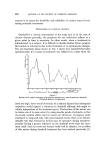
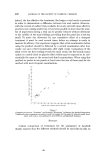
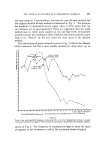
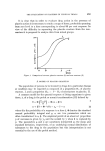
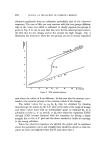
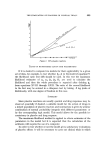
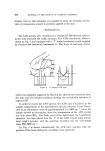
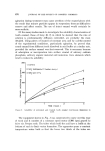
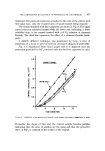
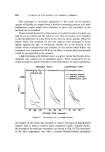
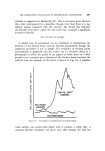
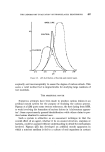
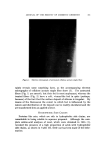
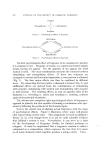
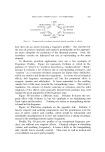
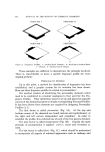
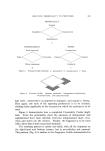
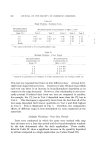
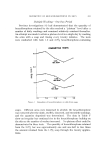
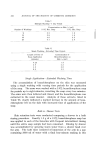
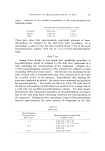
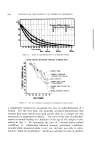
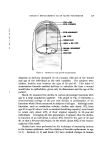
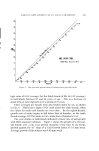
458 JOURNAL OF THE SOCIETY OF COSMETIC CHEMISTS placebo reaction as well as of pharmacological action the observed response is likely to be quantal. The distinction between graded and quantal responses to the action of drugs is not absolute since any quantitative response may be made quantal. Conversely, quantal data may be made numerical by the use of scores, particularly if there are more than two possible outcomes. Hewlett and Plackett (9) have studied the relation between the quantal and graded responses to a drug in terms of a bivariate Normal distribution of graded response and critical graded response. Since the placebo reaction is usually observed quantally it is appropriate that the corresponding drug action is also discussed in the same terms, although it might be possible in a further investigation to consider a trivariate distribution of graded response and critical graded response to drug action jointly with quantal response to placebo action. THE EFFECT OF PLACEBO REACTION ON DRUG ACTION In clinical trials as reported in the literature, where placebo reaction is considered, the usual design is equivalent, in the simplest case of one treat- ment, to allocating individuals to a group of placebo reactors or to a group of nonreactors according to the results of tests with placebos. Each of the groups is then separately tested for responses to a given dose of a drug. In a suitably designed trial the observed proportion of placebo reactors is an unbiased estimate of the proportion in the populatkm. However placebo reactors are not always consistent, for example Lasagna (10) found that 55 per cent of patients receiving the placebo were inconsistent, that is 79 per cent of reactors to the placebo did not react on every occasion they received the placebo. Similarly the response to drug action is not consistent in given individuals Berkson (11) has compared this variability with the variation in the weights of human beings from time to time and Hewlett and Plackett (9) have stated that this variation does not invalidate the interpretation of drug action on a particular occasion. It follows that if the groups are allocated by means of single observations on the placebo then each group may be contaminated by the other and so the difference in drug action on the two groups is liable to be underestimated. Moreover even if individuals in a trial are correctly allocated as reactors or not, the difference in response to an active drug will depend on the dose given in general. This is illustrated in Fig. I for a high dose A with a small difference between the groups and for a low dose B with a large difference between them.
Purchased for the exclusive use of nofirst nolast (unknown)
From: SCC Media Library & Resource Center (library.scconline.org)