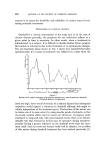
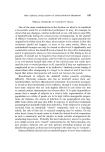
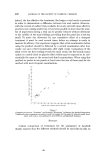
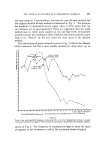
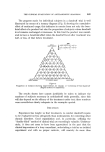
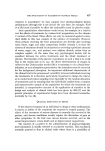
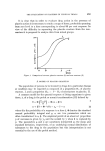
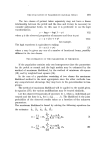
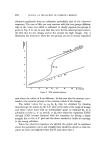
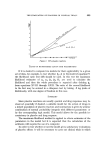
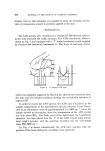
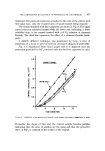
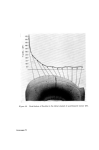
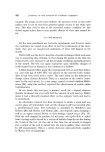
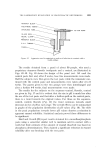
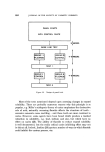
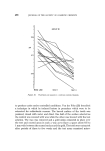
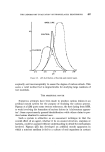
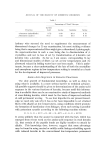
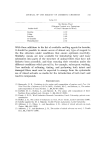
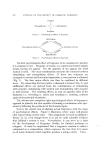
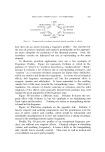
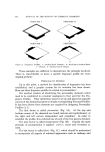
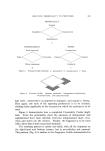
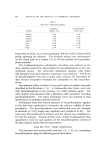
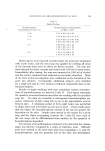
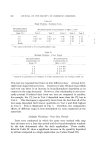
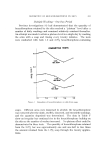
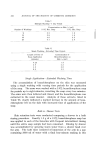
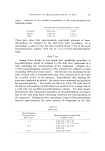
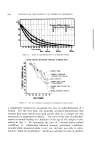
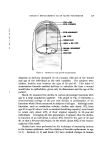
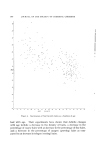
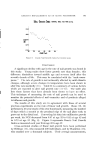
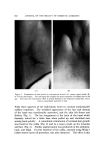
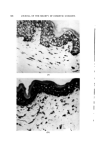
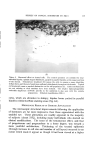
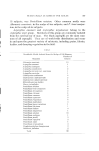
THE EVALUATION OF PLACEBOS IN CLINICAL TRIALS 459 It is clear that in order to evaluate drug action in the presence of placebo action it is necessary to study a range of doses, preferably spanning from zero level to a dose corresponding to about 95 per cent response. In view of the difficulty in separating the placebo reactors from the non- reactors it is proposed to analyse data from mixed groups. O o B A Figure I Comparison between placebo reactors (2) and non reactors (2) A MODEL OF PLACEBO REACTION The population of persons to be treated by drugs for a particular disease or condition may be regarded as composed of a proportion rI 1 of placebo reactors, I, and a proportion II 2 = 1-- II • of nonreactors to placebo, II. A common model for the quantal response of living organisms to given doses, Z, of a drug is the probit or normit transformation (12) defined by 0=•(% It) :•(a+•iZ) I i• 2 r- •Z = (I2}-1 (0) = yp -- 5 = y II where 0 is the probability of a response to a dose Z, ß denotes the standard normal probability integral and it, • are two parameters which are often transformed to a, •. The empirical probit of an observed proportion p of successes is given by y• and the normit by y when 0 is replaced by p. The parameters it and , are sometimes interpreted as the mean and standard deviation, respectively, of an underlying normal distribution of tolerances to the drug in the population but this interpretation is not essential to the use of the probit method.

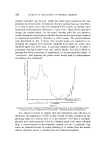
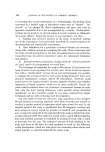
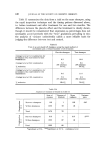
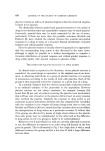
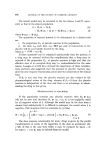
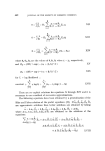
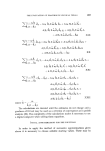
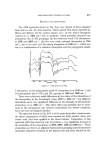
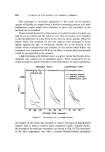
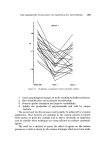
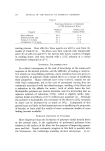
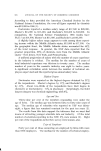
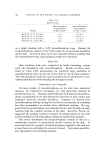
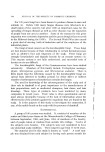
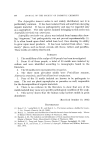
460 JOURNAL OF THE SOCIETY OF COSMETIC CHEMISTS The normit model may be extended to the two classes I and II separ- ately so that in the mixed population 0 = II1 01 + 172 02 III = rl• (P (a• + • z) + r12 (p (a2 + •2 z) IV where (P (al) (P (a2). The quantities of especial interest to be determined by a clinical trial are i. the proportion 1-] 1, of placebo reactors in the population, ii. the dose, Z0, such that, say, 99.9 per cent of nonreactors to the placebo will be successfully treated by the drug, where Z,, = ( 3.09 -- a•) / [•2. V If these quantities can be estimated satisfactorily then the potency of a drug may be assessed without the complications that a drug may be rejected if the proportion H1, of placebo reactors is high and that the effective dose of an accepted drug may be underestimated for the same reason. Lasagna et al (10) have stressed the importance of these complica- tions and have also suggested that the presence of placebo reactors may alter the dose response relationship and so alter the sensitivity of the clinical trial. If [•1 is non zero then the placebo reactors are also subject to the pharmacological action of the drug whereas if [•1=0 then the placebo reaction is independent of the dose and there is no advantage in admin- istering the drug to this group. MODIFICATIONS TO THE MODEL If the population contains any placebo reactors then l-I1 (I)(a l) will not be zero and therefore Ill • (a 1-+-[•l Z) is not negligibly small for all negative values of Z. Although the model may fit the data from a clinical trial satisfactorily it is difficult to interpret the model when Z is negative. This objection may be overcome by putting 121)= 1-[1{,- •- f (21-I)-' exp (--t2/2)dt } + 1-I2 (I)((1 2 -¾ "2Z), VI o Z•0. The dose response relationship for many drugs is given by the probit transformation in terms of the logarithm of the dose as metameter (12, p 23). If this is the case then either Z may be replaced by log ()• + g) for some )• 0 or • 1 may be deleted from the model.
Purchased for the exclusive use of nofirst nolast (unknown)
From: SCC Media Library & Resource Center (library.scconline.org)