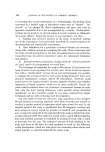
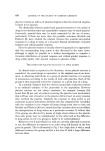
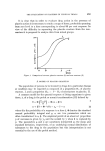
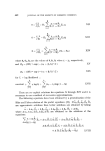
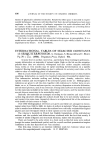
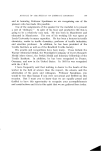
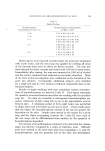
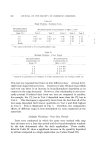
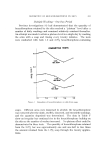
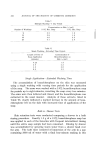
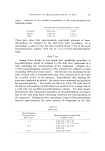
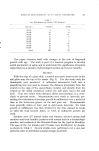
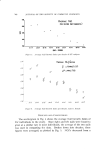
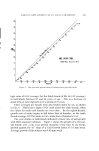
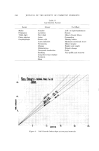
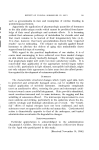
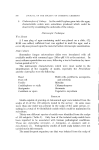
THE EVALUATION OF PLACEBOS IN CLINICAL TRIALS 461 The two classes of patient taken separately may not have a linear relationship between the probit and the dose and it may be necessary to consider polynomial forms. In this case it is preferable to use the logit transformation. y = log p -- log ( 1 -- p) VII where p is the observed proportion of successes and then to put y -- a + [I Z + 7 Z2 VIII for example. The logit transform is equivalent to taking 0 = ey/(1 + ey) IX where y may be given any one of a number of functional forms, possibly different in the two classes. THE ESTIMATION OF THE PARAMETERS IN THE MODEL If the population contains only one homogeneous class the parameters for the probit or normit and the logit models may be estimated by the method of maximum likelihood, by the method of minimum chi-square (13), and by weighted least squares (14). In the case of a population consisting of two classes the maximum likelihood method is the most appropriate since the other methods lose any computational advantage they may have in the generalization to two groups. The method of maximum likelihood will be applied to the model given in equation (IV) the various modifications may be treated similarly. Let the observed frequencies of successes be r i when n i individuals are treated and the dose is • i, for i--1,2, . . . , k. The likelihood is the joint probability of the observed results taken as a function of the unknown parameters. The maximum likelihood is found by solving the following equations for A A A A A the estimates k • ri -- ni Oi 0 • L 1-I• Z. X = •a--• = 0i ( 1 -- 0i) i•-I k Z ri -- ni 0i • L II2 0i ( 1 -- 03 Z2i XI 0 i--1

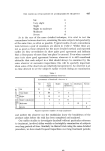
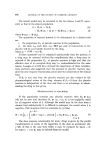
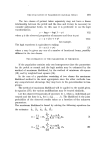
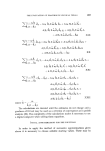
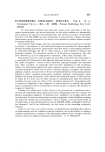
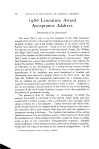
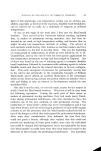
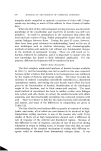
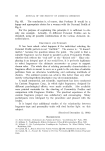
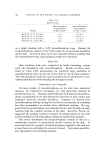
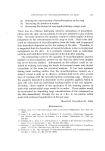
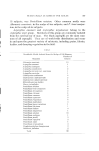
462 JOURNAL OF THE SOCIETY OF COSMETIC CHEMISTS k 0 --/) L _ • ri -- ni 0i •[5• I-l• Oi(1 --oi) Z•izi i=l XII k 0- 3 L • ri_•_ niOi • [h -- Fie • Oi ( 1 -- Oi) Z2i •i i--1 XIII k 0 • L • _ri_--_niOi • l-I1 •.-•Oi ( l • Oi) (01i -- 02i) XIV xvhere 0i, 01i, 02i are the values of 0, 0•, 02 when Z = Zi, respectively, and Z. = (211)-* exp (--(el + [• Zi)z/2 ) XV Z2i -- ( 211 )- • exp (-- ( a2 + [•2 Zi)2 / 2 ) XVI for L • log likelihood = k k constant + • ri log 0i + •(ni-- ri) log (1 -- i=l i=l Oi) XVII There are no explicit solutions for equations X through XIV and it is necessary to use a method of successive approximations. The following equations have been obtained by a generalization of the A A A A A Bliss and Fisher solution of the probit equations (12). If el, [•, a2, [t2, iI• are approximate solutions then better solutions are obtained by taking A A A A R + A•I,•I + A•l,•t2+A•2,•2 + A•2, 1 +Alii, where A a•, A a2, A •, A •2, A Ill are obtained as the solutions of the equations: A -- •-- Zli • A (•1 lil •'• 0)i Zli -•- A (•2 li2 •'• o)i Zli 2i -•- tOi ( 1 --Oi) A A A2 A A A A •1 lil Z 0)i Zli Zi 21- A [•2 I-I2 Y• COl Zli Z2i •,i & A A + A li• Z (oi Zli ( 0ii -- •) XVIII
Purchased for the exclusive use of nofirst nolast (unknown)
From: SCC Media Library & Resource Center (library.scconline.org)