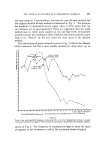
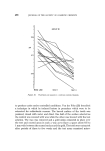
444 JOURNAL OF THE SOCIETY OF COSMETIC CHEMISTS to recording the overall impressions of a dermatologist, the findings being expressed in a limited range of descriptive terms such as "cleared", "im- proved" or "no change"(3). Brief consideration will show that such an approach (especially if it is not accompanied by a strictly "double-blind" routine) leaves much to be desired unless it is only required to distinguish all-or-none efficacy. Important factors, in our experience, are that:-- i. Training and extensive practice in the study of dandruff, making use of the concordance tests previously described {1), are pre-requisites for discriminating and reproducible assessments. ii. Clear definitions for a gradation of clinical features are necessary, along with a definite system for examining the scalp. Observations may take the form of word descriptions at the time of examination but are preferably transcribed into pre-selected numerical values for subsequent tabulation and analysis. iii. Intervals between inspections, during which the various treatments are used, need to be programmed on sound lines. The technique of examining the scalp in 25 sections (1) has formed the basis of much of our experience for several years. If this is used in conjunc- tion with a "double-blind" system of test and control panels, it is possible to compare the average trends for each panel during treatment. Since each physical examination occupies almost 30 min/subject, relatively small panels have to be employed and it becomes arguable whether a less detailed inspection of larger numbers would not be more profitable. Clearly the point could be reached where the technique of assessment became so crude that only the most glaring differences could possibly attain statistical significance we have therefore sought to test some comparatively simple techniques and are still continuing such investigations. Our own staff of observers, who have long experience in the detailed, 30 min method of assessing dandruff, have more recently been trained to conduct a quicker method of inspection which takes about five min. In the detailed method the scalp is partitioned into 25 imaginary sections and each section in turn is scored for severity of dandruff and proportion of area occupied by dandruff in the rapid method the scalp is divided into four sections instead of 25. The subject is seated under a good diffused lighting and each notional quadrant is examined by parting the hair with a comb at intervals over the area. The estimated amount of scale attached to the scalp {not loose in the hair) for each quadrant is rated by the following verbal descriptions, which are later given the numerical values shown and added together to yield the index for the whole scalp.

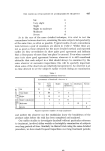
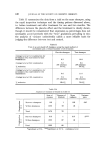
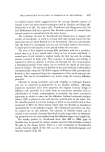
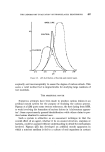
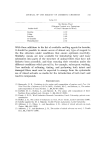
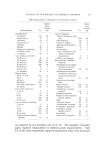
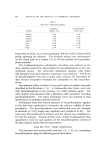
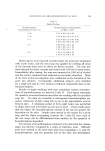
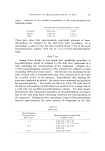
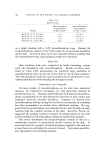
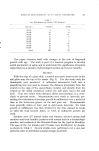
THE CLINICAL EVALUATION OF ANTIDANDRUFF SHAMPOOS 445 Nil 0 Very slight 1 Slight 2 Slight to moderate 3 Moderate 4 Severe 8 As in the case of the more detailed technique, it is vital to test the concordance between observers, examining the same subjects independently at the same time, as often as possible. Typical results of such concordance tests between a pair of examiners are shown in Table I. Whilst these are not as good as those obtained for the more detailed method and reported earlier (1) they nevertheless do show quite good agreement and indicate that a discrepancy of more than 'one place' is unusual. Even when concord- ance tests show good agreement between observers it is still considered advisable that each subject in a trial should always be examined by the same observer at successive inspections this will be specially important when some of the observers are relatively inexperienced. An observer is at no time allowed to see the subject's earlier records during an examination Table I Concordance between observers Assessment of dandruff: observer A Nil Very Slight Slight to Moderate Severe slight moderate Nil 21 6 Very slight 9 58 5 2 Slight 1 10 6 4 Slight to moderate 4 4 11 Moderate 1 1 4 15 -- Severe 5 Figures represent number of scalp quadrants and neither the observer nor the statistician know the breakdown of the product codes before the trial has been completed and analysed. Our earlier studies to investigate dandruff without particular reference to treatment, involved either weekly or fortnightly examination of subjects over long periods of time. Similarly in clinical trials using the same detailed procedure, we have made frequent inspections over long treatment periods
Purchased for the exclusive use of nofirst nolast (unknown)
From: SCC Media Library & Resource Center (library.scconline.org)