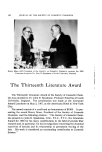
504 JOURNAL OF THE SOCIETY OF COSMETIC CHEMISTS First, he has been a leader and developer of some of the most im- portant ingredients of modern society, the educated man, the teacher, and the scientific researcher. With some 75 advanced degree students and countless others, his record is unsurpassed in the field of textile education. I doubt if there is a major school or research organization concerned with wool or hair that has not been a beneficiary of some of these people. As a matter of fact, a research organization which bears a familiar name, the Harris Research Laboratories, is the proud pos- sessor of five of his Ph.D. students. Perhaps I should mention this with fear and trepidation because today there exists an emotion-packed international problem called the "brain drain" in which the United States is usually cast as the villain. Actually the United States was the beneficiary of Professor Speakman's work and many of his students before anyone ever heard of the politically- sensitive term called the "brain drain." Nonetheless, we will be prudent today and speak softly--we would not like to send our honored guest back to his native land and have him be received as something less than a conquering hero. Without digressing, I do want to submit that the world needs more of this type of "brain drain." In a world of constant strife and poor or no communications in many areas, we in the field of science can proudly point to continued and objective dialogues in many areas and at all levels. In the long run it is my sincere belief that the pattern we are setting in the area of science will become the pattern for international communications between countries. In addition to his contributions in the field of education, his work, as well as that of his students has had a profound effect on two major industries with which many of those here today have been associated the cosmetic industry and the textile industry. Such developments as permanent waving, setting and hair dyeinõ in the cosmetic industry and shrink proofing, bleaching, dyeinõ and many other finishing processes in the textile industry find some roots in much of his work. It is not too many years ago that the cosmetic industry was a purveyor of witches brews and nostrums. Nor was it too many years ago that the textile industries were largely family-held craft organizations devoid of science as we know it today. Today they are gigantic industries which boast of large research and development organizations that compare in scientific and technological sophistication with many modern industries. We as technical people can be justly proud of them

JOURNAl, OF THE SOCIETY OF COSMETIC CHEMISTS 50•5 and in honoring Professor Speakman we are recognizing one of the pioneers who has made this possible. One of the assignments of the speaker for the medalist is to present a sort of "obituary." In spite of his busy and productive life this is going to be a relatively easy task. He was born in Manchester and educated in Manchester. The rest of his working life was spent at Leeds University in many capacities. He has been a lecturer in textile chemistry, reader in textile chemistry, professor of textile industries, and emeritus professor. In addition, he has been president of the Textile Institute as well as of the Bradford Textile Society. His awards and recognitions have been many. These include the Warner Memorial Medal, the Worshipful Company of Dyers Research Medal (three times), the Perkin Medal and honorary fellowship of the Textile Institute. In addition, he has been recognized in France, Germany, and now in the United States. In 1963 he was recognized with the C.B.E. I have frequently said that nothing is dearer to the hearts of the worker in the field of science than the respect, the esteem, and the admiration of his peers and colleagues. Professor Speakman, you would be less than human if you were not proud and thrilled on this occasion. But I want you to know that we are equally proud and thrilled to have this opportunity to recognize your accomplishments and contributions and it is in this spirit that we are gathered here today.
Purchased for the exclusive use of nofirst nolast (unknown)
From: SCC Media Library & Resource Center (library.scconline.org)