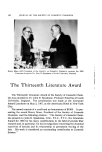
506 JOURNAL OF THE SOCIETY OF COSMETIC CHEMISTS 966 Literature Award Acceptance Address P•OVESSO• J. B. SPEXKMXN* The news that I was to be the recipient of the 1966 Literature Award of the SOCIETY O1' COSMETIC CHEMISTS came as a great and very pleasant surprise, and I am deeply conscious of the honor which the Society has conferred upon me. Great as is my own delight, it would have given even greater pleasure to two old friends of mine, Mr. William and Hugh MacDonald, now deceased, who may be known to some of you as the founders of MacDonald steam waving. It was through them that I came to take an interest in permanent waving processes. Hugh MacDonald was a practicing hairdresser in Inverness, who enlisted the help of his brother, William, a graduate in mathematics of the University of Aberdeen, in the development of a steam-waving process shortly after the end of World War I. In this they were so successful that the manufacture of the machines was soon transferred to London, and showrooms were opened in Regent Street in the West End. By this time Mr. William had abandoned mathematics for a business career, but he satisfied his scientific interests by following the progress of research on human hair and related fibers, such as wool. Unknown to me, he was taking a special interest in our work on one of the finishing processes of the wool textile industry, because of its close similarity to his method of permanent waving. The process is that of "blowing" or "decatizing," in which the scoured wool cloth is stretched to the desired width, dried, and then wound with a cotton wrapper onto a perforated roller through which steam is blown for a few minutes. Unlike stretched and dried cloth, which would return to its original width on being released in cold water, the stretched, dried, and steamed cloth does not, and the similarity to permanent waving is obvious. The chemical mechanism of the setting (fixation) process was investigated, and by 1933 it had been shown that the permanent set which strained wool fibers acquire in steam or boiling water is due to two consecutive intramolecular reactions: disulfide bond breakdown, which dissipates stress, followed by linkage rebuilding, which fixes the relaxed structure in the strained configuration. In the * Professor Emeritus, Leeds University, England.

JOURNAL OF THE SOCIETY OF COSMETIC CHEMISTS 507 light of this knowledge, low-temperature setting was an obvious pos- sibility, especially as the first of the reactions, disulfide bond breakdown, can be carried out so easily by a multitude of reagents at ordinary temperatures. It was at this stage of the work that I first met the MacDonald brothers. They arrived at the University without warning, explained that, as makers of permanent waving machines, they had been in- terested in our work on high-temperature setting, and foresaw that we might develop low-temperature methods of setting. The advent of such methods would destroy their business as machine makers and they must, therefore, be the first to develop them. This was the beginning of a long period of collaboration, in which we were joined by Dr. N.H. Chamberlain, and by the end of 1934 the first patent applications for low-temperature permanent waving had been lodged in England. One of these was based on the use of reducing agents to promote disulfide bond breakdown, followed by treatment with oxidizing agents to reform disulfide bonds and thus fix the relaxed structure in its new configura- tion. This early emergence of processes for permanently waving hair in the cold is due principally to the remarkable foresight of William MacDonald, and it affords an excellent illustration of the advantages which accrue from having at least one person within an industry who is able and willing to take an interest in developments outside his own specialized field. But this is not the only, or even the main, reason for the respect in which I hold the MacDonald brothers. What this is will be clear from the following experience. During the early part of their career as makers of permanent waving machines, they had made many friend- ships among professional hairdressers, who were intended to have the exclusive use of the new methods of cold permanent waving. The production of "home-perm" outfits was never contemplated, and it was only when what is now one of the largest producers of such outfits sought a license to use the processes, that the MacDonalds realized the full ex- tent of the danger to which they had exposed the professional hairdresser. After some days' consideration, they informed the firm that they could not grant a license, although they realized that this could not prevent the marketing of home-perm outfits, since only the individual user could be charged with infringement, but it was impossible for them (the MacDonalds) to profit from what they then believed would be the distresses of their friends, the professional hairdressers. The matchless
Purchased for the exclusive use of nofirst nolast (unknown)
From: SCC Media Library & Resource Center (library.scconline.org)