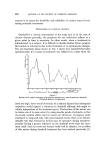
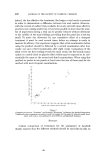
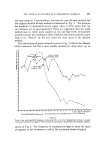
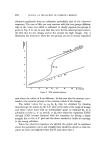
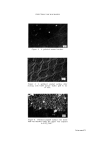
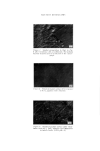
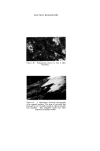
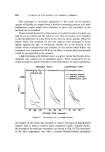
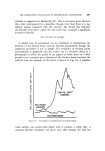
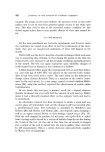
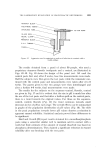
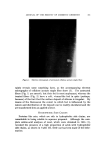
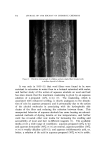
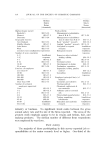
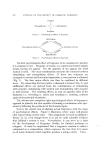
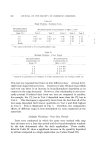
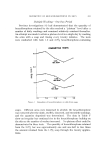
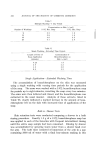
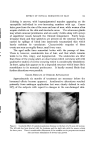
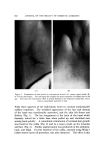
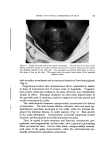
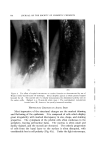
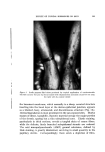
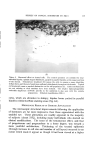
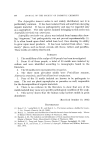
512 JOURNAL OF THE SOCIETY OF COSMETIC CHEMISTS Ftgure 2. .• . . • •:' .':•,• ?(• • .*,7 :-:.'.::.:x. :•- ,•. •.'.•.-- ... Electron mirograph of cellulose aee•te staple fiber treated with a surface deposit of silicone It was only in 1959 (6) that wool fibers were found to be more resistant to extension in water than in n-butanol saturated with water, and further study of the action of aqueous alcohols on wool and hair has since shown that the maximum weakening is given by an aqueous solution of n-propanol (45% w/w) (7). The weakening, which is associated with enhanced swelling, is clearly analogous to the dissolu- tion of zein by aqueous propanol, and is presumably due to the action of the alcohol molecules in associating with the hydrophobic side chains of the fiber and reducing the cohesion between them. This unexpected behavior of aqueous alcohols has some bearing on solvent- assisted methods of dyeing keratin at low temperatures, and further work has revealed other new media for increasing the swelling and accessibility of wool and hair to different reagents (7). The available media cover a wide range of conditions: aqueous propanol (45% w/w) and aqueous formamide (89% w/w) are neutral, aqueous pyridine (54% w/w) is weakly alkaline (pH 8.3), and aqueous trichloroacetic acid, or, better, a solution of the acid in aqueous propanol (50% w/w) is acidic.

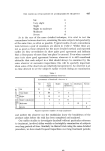
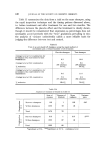
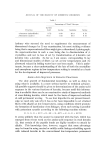
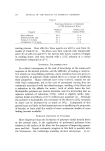
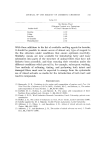
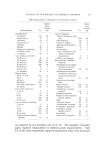
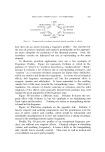
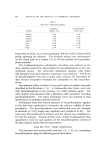
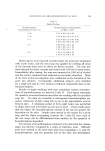
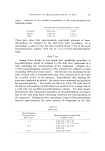
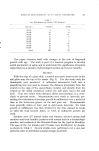
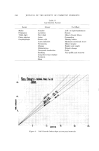
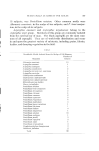
JOURNAL OF THE SOCIETY OF COSMETIC CHEMISTS .513 Table III Amino-Acid 64s Merino Wool Nitrogen Content as a Percentage of Total Nitrogen in Wool) Alaninc 4.12 Valine 4.16 Leucine 5.85 iso-Leucine 2.44 Phenylalanine 2.12 With these additions to the list of available swelling agents for keratin, it should be possible to ensure access of almost any type of reagent to the fine structure under conditions that ensure optimum reactivity. Similarly, means are now available for introducing fatty and waxy substances into parts of the structure of animal fibers that have not hitherto been accessible, and thus ensuring their retention under the different conditions which prevail in, for example, subsequent washing. New methods of softening, tinting, and perfuming both intact and damaged fibers must now be expected to emerge from the systematic use of mixed solvents as media for the introduction of both inert and reactive compounds. REiCERENCES (1) Simmonds, D. H., Variations in the amino acid composition of •nerino wool, Proc. Int Wool Text. Res. Conference, C 65-74 (1955) Corfield, M. C., and Robson, A., The amino acid composition of wool, Blochem. J., 59, 62-68 (1955). (2) Corfield, M. C., Robson, A., and Skinner, B., The a•nino acid compositions of three fractions from oxidised wool, Blochem. J., 68,348-52 (1958). (3) Cassie, A. B. D., Wool Industries Research Association, Leeds University, private com- munication. (4) Holker, J. R., The action of reductone on wool, Ph.D. Thesis, Leeds University (1956). (5) Kindly supplied by Dr. J. Sikorski, Textile Physics Laboratory, Leeds University. (6) Atkinson, J. C., Filson, A., and Speakman, J. B., Action of mixed solvents on wool, Nature, 184,444 (1959). (7) Atkinson, J. C., and Speakman, J. B., The action of mixed solvents on wool, .[. Textile Inst., 55, T433-47 (1964).
Purchased for the exclusive use of nofirst nolast (unknown)
From: SCC Media Library & Resource Center (library.scconline.org)