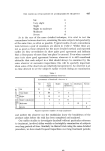
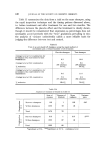
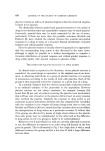
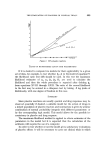
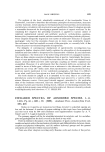
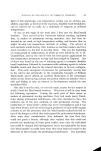
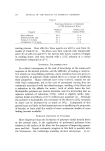
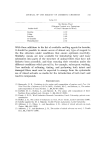
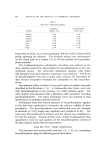
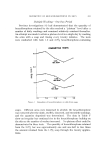
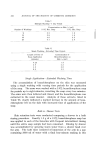
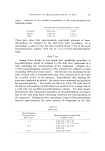
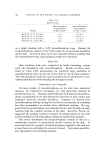
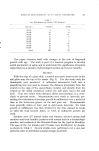
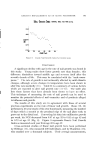
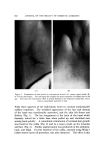
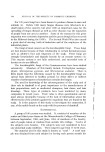
JOURNAL OF THE SOCIETY OF COSMETIC CHEMISTS Table II Percentage Reduction in Resistance to 25% Extension in Water Reduced Reduced and Reagent Fibers Oxidized Fibers Mesoxaldehyde 33.3 14.8 Dehydroascorbic acid 33.1 13.0 Pentan-2: 3: 4-trione 31.1 12.9 Cyclopentan- 1: 2: 3-trione 31.1 - 0.6 waving process. How effective these agents are will be seen from the results of Table II (4). The fibers were first reduced with thioglycollic acid (M) at pH 4.55 and 25 øC for twenty-four hours, washed overnight in running water, and then treated with a 2.5% solution of a vicihal tricarbonyl compound at 25 øC. INTERNAL POLYMERIZATION As a direct consequence of the lack of knowledge of the amino-acid sequence in the keratin proteins, and the difficulty of making a construc- tive attack on cross-linking problems, much attention has been given to the synthesis of polymers inside animal fibers as a means of modifying their properties. Many methods have been evolved, usually for use with vinyl compounds, but in the case of permanent waving they are commonly associated with two disadvantages, swelling of the fibers and a reduction in the affinity for water both of which harm the feel. Hydrophilic polymers are dearly desirable, and it is interesting that an aqueous solution of reductone (10%), which is slightly acidic, poly- merizes inside wool fibers at 25 øC without any assistant (4). Although the polymer is hydrophilic, the resistance of the fibers to 25• extension in water can be increased by as much as 54%. Compounds of this general type are likely to find important uses in modifying the properties of keratin, at least until the results of more systematic studies of cross linking become available. SURFACE DEPOSITS OF POLYMER More important than the fmmation of polymers inside keratin fibers at the present time, is the application of preformed polymers from solution to the surface of the fibers for the purpose of improving appear- ance and feel. Rapid systematic progress in this field is possible with the Stereoscan--the Cambridge scanning electron microscope. It cer-

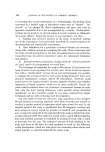
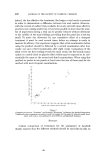
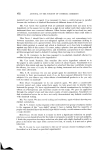
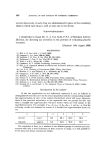
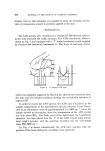
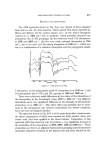
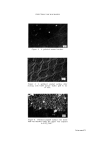
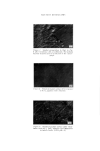
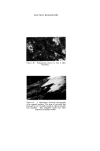
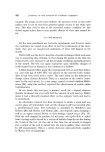
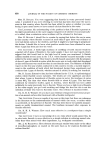
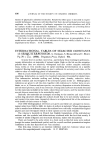
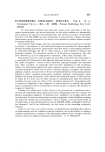
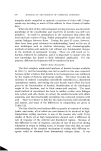
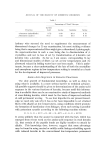
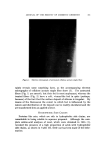
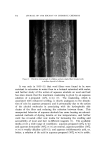
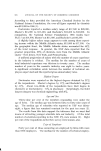
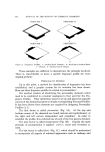
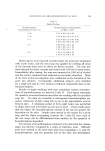
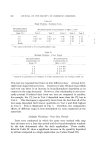
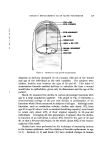
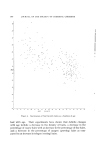
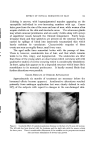
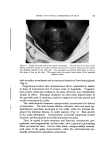
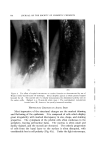
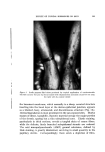
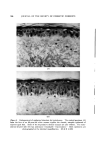
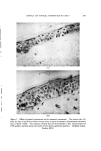
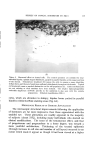
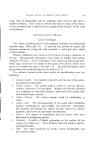
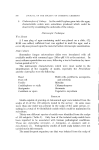
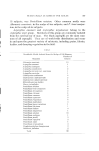
JOURNa, L OF THE SOCIETY OF COSMETIC CHEMISTS ,511 ::4 ,. ,: ß Figure 1. Electron micrograph of untreated cellulose acetate staple fibcr. tainly reveals some surprising facts, as the accompanying electron micrographs of cellulose acetate staple fiber show (5). The untreated fibers (Fig. 1) are smooth, but their feel is most unpleasant, whereas the treated fibers (Fig. 2) have a soft, vicuna-like feel in spite (perhaps, because) of the fact that the surface deposit of silicone is irregular. By means of the Stereoscan the extent to which feel is influenced by the nature and distribution of the deposit can be readily elucidated and the art transformed into an applied science. HYDROPHOBIC SIDE-CHAINS Proteins like zein, which are rich in hydrophobic side chains, are remarkable in being soluble in aqueous propanol. Although the com- plete amino-acid analyses of wool, which were obtained in 1955 (1), revealed the presence of a high proportion of acids with hydrophobic side chains, as shown in Table III, little use has been made of the infor- mation.
Purchased for the exclusive use of nofirst nolast (unknown)
From: SCC Media Library & Resource Center (library.scconline.org)