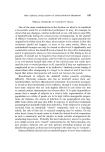
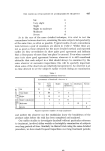
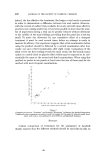
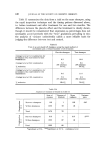
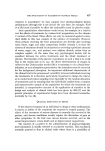
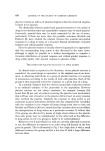
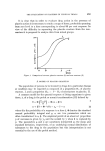
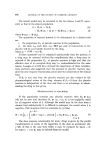
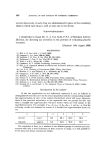
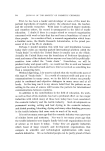
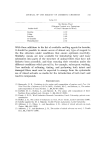
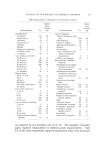
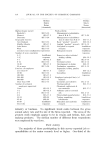
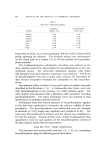
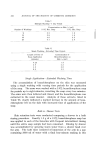
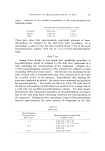
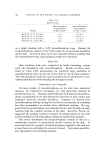
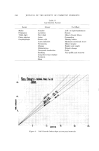
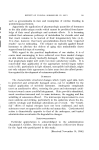
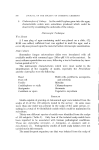
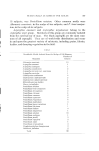
534 JOURNAL OF THE SOCIETY OF COSMETIC CHEMISTS Table VIII Bath Oil Tests Product Hexachlorophene Concentration in Bath (rag/l) Hexachlorophene Concentration on Arm (T/cm 2) Bath Oil "A" (3.0% Hex.) Bath Oil "B" (4.0% Hex.) Bath Oil "C" (1.0% Hex.) Bath Oil "D" (3.0% Hex.) 6.0 4.2-8.2 12.0 10.6-17.4 3.0 2.7-4.2 10.0 5.2-6.8 as a single washing with a 2.0% hexachlorophene soap. Raising the hexachlorophene content of the bath results in an increased deposition on the skin. Several of these tests were repeated without washing with the nonmedicated soap, and analogous results were obtained. Bath Oils Skin retention tests were conducted in baths containing various bath oils [ormulated with hexachlorophene. Results of these tests, listed in Table VIII, demonstrate the relatively large quantities of hexachlorophene that can be put on the skin by use of these products. The wide spread in results for a given product can be attributed to non- uniform distribution of the floating oils through the bath. DISCUSSION AND SUMMARY Previous studies of hexachlorophene on the skin have employed bioassay (3), radioactive techniques (4), and ultraviolet analysis of alcohol extracts (5). Shemano and Nickerson (4) found that hexachloro- phene accumulated on the skin during the first three or four washes and remained relatively constant thereafter. Compeau (5) showed that hexachlorophene builtup during the first five to ten minutes of scrubbing but then accumulated no further after additional washing. He sug- gested that hexachlorophene was adsorbed on the skin through an ionic reaction with the cationic proteins of the skin. Recently, Parran (9) suggested the analogy between retention of antimicrobials on the skin and the problem of soil redeposition during the laundering of clothes. This study determined the hexachlorophene content of skin by a colorimetric analysis of concentrated alcohol extracts of the skin. It was found that the quantity of hexachlorophene applied to the skin was a major factor in controlling the amount retained. Increasing quantities were deposited by the following methods:

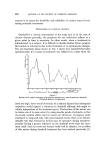
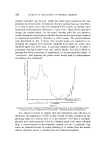
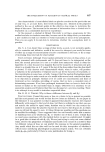
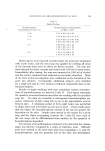
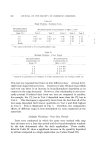
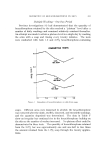
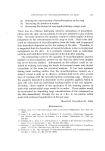
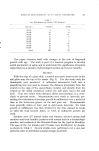
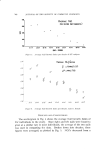
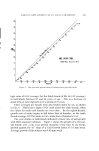
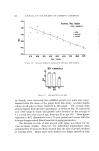
DEPOSITION OF HEXACHLOROPHENE ON SKIN 535 (a) Raising the concentration of hexachlorophene in the soap (b) Increasing the number of washes (c) Increasing the amount of soap applied during a single wash There was no evidence indicating selective adsorption of hexachloro- phene onto the skin, and no plateau levels were attained in any of these tests. In many' instances the quantity retained varied roughly in direct proportion to the concentration in the soap or bath. Bath tests indi- cated no exhaustion of hexachlorophene from the bath, and it appeared that deposition depended on the wet pickup of the skin. Therefore, it is suggested that the deposition of hexachlorophene is due to its physical entrapment on the skin. It is probably retained both as individual particles and solubilized in the soap left on the skin after washing. The relationship between the quantity of hexachlorophene and the number of microorganisms present on the skin has often been implied but never directly studied. Information on this subject could be ob- tained in washing tests using the hands for bacterial counts and alcohol extractions of the arms for chemical analysis. It has been assumed during hand washing studies that the hexachlorophene content on a subject's hand is built up to effective antimicrobial levels after several days of washing with the hexachlorophene-containing soap. However, the quantity deposited is dependent on the quantity applied, which in turn will vary with the individual washing habits of the test subjects. Therefore, closer control of the mechanics of the washing process in tests with antimicrobial soaps would be in order. These studies would be accelerated by depositing large concentrations of the compound on the skin immediately through the use of a five to ten minute initial wash with continual reapplication of the test soap. (Received November 30, 1966) REFERENCES (1) Sindar Corp., G-ll (Hexachlorophene USP) an annotated bibliography, Tech. Bull. H-1 (1965). (2) Cade, A. R., and Gump, W. S., in Reddish, G. F., Antiseptics, Disinfectants, Fungicities, and Chemical and •Physical Sterilization, Lea & Febiger, Philadelphia, Pa., 1957, pp. 319-354. (3) Fahlberg, W. J., Swan, J. C., and Seastone, C. V., Studies on the retention of hexachloro- phene (G-11) in human skin, J. Bact., 56, 323--328 (1948). (4) Shemano, I., and Nickerson, M., Cutaneous accumulation and retention of hexachloro- phene --C TM (G-11), Federation •øroc., 13, Part 1,405 (1954). (5) Compeau, G. M., The adsorption of dodecylbenzenesulfonate and hexachlorophene on the skin, J. •Pharm. Sci., 49,574-580 (1960).
Purchased for the exclusive use of nofirst nolast (unknown)
From: SCC Media Library & Resource Center (library.scconline.org)