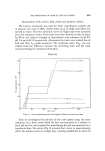
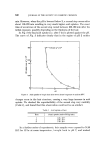
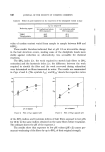
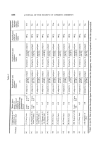
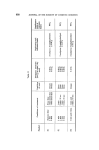
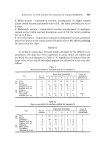
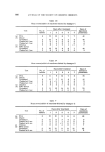
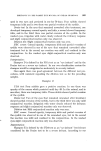
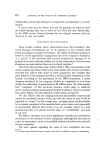
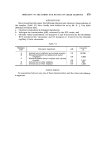
QUANTITATIVE ESTIMATION OF DETERGENCY OF SHAMPOOS 657 some soil redeposition took place during the course of the second minute of shampooing. A further repeat of the same experiment, carried out after another three months, no longer showed this effect. There may be many reasons why soil redeposition should take place on some occasions and not on others, but this is not relevant to the present subject matter. However, it is important that such effects are directly measurable and that they are shown not to happen consistently even with the one product. This is clearly an important consideration in such matters as hair conditioning studies where many effects may depend on the amount of soil remaining on the hair. To some extent these figures show why any long-term assessment of hair conditioning effects in practice is so difficult since, apart from the enormous random variation of hair from one person to another, the be- haviour of the whole shampoo and allied system itself is so irregular, under the same nominal conditions. In experiment 10 greater cleansing occurred at the higher shampoo time, the effect showing significance at the 99% level, with sufficient replication. Again, at the 99% level, these results differ significantly from those of the same experiment done earlier. A similar effect is shown by experiments 11 and 12. EXTENSION OF TECHNIQUE TO MEASUREMENT OF OTHER PROPERTIES The technique has also been used to assess the amount of detergent irreversibly retained by hair as a result of shampooing. Thus, after the gravimetric assessment of soil loss, an appropriate weight of the wool sample (about 0.015g) was subjected to a suitable procedure for the ex- traction and estimation of micro quantities of anionic detergent from protein (2). Percent detergent retained was expressed on the basis of dry, clean wool. Results These are shown in Table II. Product (f) was Sipon WD (sodium lauryl sulphate found better than 99.9% pure). Discussion In the case of product (f), used on greasy wool, only the time of sham- pooing played any significant part in determining the amount of detergent retained. Where the experiment was repeated with wool which had previously been solvent extracted the rinsing time also governed the

658 JOURNAL OF THE SOCIETY OF COSMETIC CHEMISTS
Purchased for the exclusive use of nofirst nolast (unknown)
From: SCC Media Library & Resource Center (library.scconline.org)