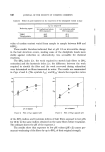
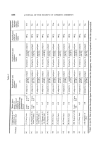
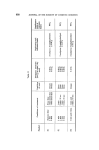
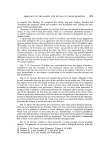
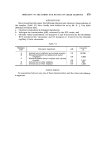
IRRITANCY TO THE RABBIT EYE MUCOSA OF CREAM SHAMPOOS 679 .4 DDEND UM Since presenting this paper the following physical and chemical characteristics of the samples (Table VI) have kindly been studied for us by Mr. N.J. Van Abb6 {Beecham Products UK): a. Chemical composition of detergent ingredients b. hydrogen ion concentration (pH), measured by the EIL meter and c. viscosity values (centistokes): for shampoos A and B measured by the Brookfield RVT synchro-lectric viscometer, and for shampoos C, D and E by the Ostwald capillary G-tube viscometer. Table VI Shampoo viscosity code Detergent ingredient pH cS Sodium lauryl sulphate and sodium stearate Monophenylamine and ammonium lauryl sulphates Monoethylamine lauryl sulphate and calcium stearate Sodium lauryl ether sulphate Sodium lauryl ether sulphate 7.9 6.8 6.6 6.2 6.0 30,750 4,883 1,041 358 1,029 CONCLUSION No association between any one of these characteristics and the observed irritancy is apparent.

J. Soc. Cosmetic Chemists 18 681-691 (1967) (•) 1967 Society ol' Cosmetic Chemists qf Great Britain Contact dermatitis from cosmetics E. CRONIN* Presented at the Symposium on "Product Testing", organised by the Society of Cosmetic Chemists of Great Britain in Eastbourne, Sussex, o, 15th November 1966. Synopsis--Allergic reactions to cosmetics are described and the difficulties in technique and interpretation of patch tests are discussed. Lipstick, nail varnish and hair dyes are the most common sensitizers but sensitivity to lanolin also occurs. An unusual urticarial reaction to hair bleach and a phototoxic effect of perfume are described. In relation to the vast amount of cosmetics used, it is true to say that it is uncommon for cosmetics to cause allergic contact dermatitis. However, from the point of vie•v of a dermatologist, allergy to some types of cosmetics is by no means a rarity. At St. John's Hospital for Diseases of the Skin in London, in the period 1960-1965, we have seen and investigated patients •vho have developed dermatitis from lipsticks, nail varnish, hair dyes, foundation creams and other types of cold creams and face creams, face pow0er and mascara. To establish the diagnosis of an allergic contact dermatitis, patients are investigated by patch testing. Unfortunately, particularly in the hands of the inexperienced, this technique has many pitfalls. Magnusson (1, 2) has shown that both toxic and allergic reactions can be influenced by the type of plaster used and the site of application of the patch test. He found diminished toxic and allergic responses, to a standard amount of chemical, when applied on a patch test in which the size of the lint was comparatively large and it was not isolated from the surrounding adhesive by Cellophane. He also found that reaction to a toxic chemical was greater on the upper * The Institute of Dermatology, London, W.C.2. 681
Purchased for the exclusive use of nofirst nolast (unknown)
From: SCC Media Library & Resource Center (library.scconline.org)