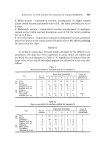
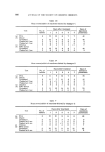
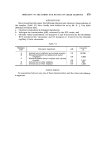
QUANTITATIVE ESTIMATION OF DETERGENCY OF SHAMPOOS 661 DISCUSSION MR. K. V. CURRY: 1. What is "wool spun in the grease"? 2. Is the grease a mineral oil? MR. BRASCH: 1. It is the same wool•vhich Barnett and Powers used in their original laboratory work. 2. Just natural wool fat. It is easily recognisable from the smell of the yarn. MR. K. V. CURRY: Have you studied your wool fats before and after the shampooing process to see whether there is any build-up of specific components in the residue as opposed to the original? MR. BRAscm No, but in the subsequent work (:3) we cut a bit of hair off a person's head, did some tic runs on the ether and alcohol extracts therefrom, and after the shampoo did the same thing with a batch of hair next to this. From a qualitative point of view, xve found only relatively few components removed, although there was some quantitative removal of each component. MR. I(. V. CURRY: I think most of this work describes single applications. Do you get any more off with successive treatments? MR. BR•scu: V•e have never tried a double application. Although the figures quoted here are absolute percentages of fat removed, they represent something like a 98.5% loss of fatty matter as a result of one shampoo. MR. K. V. CURRY: Could this technique be applied using the familiar half-head technique where you have, say, skeins of wool washed with one product, and skeins washed in the other? MR. BRAscu: I would say yes. M•. E. W. CLARK: I wish to mention a point of interest concerning the use of raw wool for assessing the detergency. If it is truly all wool with a natural grease on it, it will also have other organic secretions, i.e. the dried sweat which is highly surface active and is capable of degreasing the wool almost entirely on its own even by soaking in hot water. Could this not lead to false interpretations of results? M•. BRAscu: In a sense, you are right. If there is any value in this method it lies in using it as a comparative method. For instance, if one wants to compare two detergents which are suspected of giving widely different effects. One would get a comparison and it does not seem to me to matter greatly whether the absolute figures are inflated by virtue of the effects you mentioned provided, of course, one bears your criticism in mind. MR. E. W. CLARK: IS the wool of a standard quality? Different qualities of wool can vary temendously in the ratio of grease to other matter. MR. BRAscu: It is of a standard quality in the sense that it is supplied as a standard product for testing purposes by the Lowell Textile people in America, and I have given figures for the grease removal as a result of extraction from two different skeins. I believe the delivery of the skeins in our case •vas something like three to five years apart. We had a large stock in the laboratory from some previous work and then again, more recently, brought in some more. In the case of the early skein, for instance, we found 10% by weight of removable fatty matter whilst the skein

662 JOURNAL OF THE SOCIETY OF COSMETIC CHEMISTS received five years later contained 9.66%. It seems to me that this small difference is indicative that it is a fairly standard product over many years. MR. E. W. C•-ARK: Yes, unless you have compensating errors of some kind, because the degree of autoxidation of wool fat can have quite a large effect upon its ease of removal. In the finely divided form on the wool fibres autoxidation is quite rapid. In five years there would be a high degree of autoxidation. MR. BRASCH: I appreciate that. This does not seem to have had any drastic effect on the ease of quantitative removal of the fat from the wool. I cannot vouch for the fact that there may not have been some oxidation inhibitor of some sort included during the preparation of the yarn. MR. E. W. C•.•RK: In the test it might pay to have a standard shampoo formu- lation to assess the wool sample itself. MR. BR•scu: Yes, indeed. Our standard baseline was merely the solvent ex- tractability, but I agree that a standard shampoo in addition may be very valuable. MR. K. V. CuRRy: Have you repeated any of this work using hair? Do you get the same high detergency with hair as you do with wool? MR. BR•scm We have not repeated this on hair in quite the same way because it is very difficult to get a large quantity of hair to use over a long period of study which is as uniform as standard prepared wool, for example. Quite apart from this, to tie or devise some means of holding hair in a bundle of one form or another on the fingers is very difficult indeed. We did try wrapping hair up in cushions made from gauze, but this seemed to be getting a little remote from practice. We therefore did not pursue this. As I mentioned above, we used a similar approach if not an identical technique. We took various female models and selected parts of the hair near their necks so when we cut off approx. 0.Sg it xvould not show. This was done both im- mediately before and after shampooing, the samples of hair being next to each other. The residual amount of fatty matter was quantitatively estimated by solvent extraction. We only achieved a removal of something like 40% of the fat from the hair as opposed to something like 98% when we used wool.
Purchased for the exclusive use of nofirst nolast (unknown)
From: SCC Media Library & Resource Center (library.scconline.org)