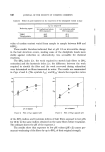
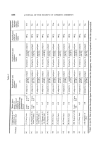
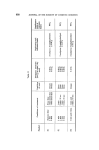
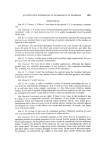
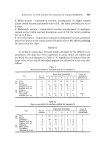
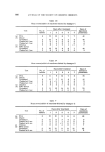
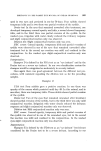
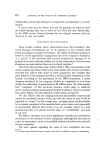
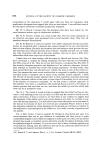
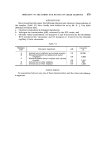
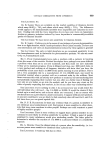
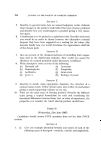
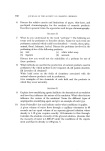
JOURNAL OF THE SOCIETY OF COSMETIC CHEMISTS Table Halogenated fluoresceins in the various shades of lip- sticks, either as such or as natural commercial lakes. None. Dibromo alone. Dibromo plus tetrachloro- tetrabromo. Di-iodo alone. Di-iodo plus tetrachloro- tetrabromo. Di-iodo and tetrabromo. Di-iodo plus tetrabromo plus tetrachlorot etrabromo. Tetrabromo alone. Te(rabromo plus (etrachloro- tetrabromo. Average incidence of med- ical complaints expressed as a mean over the num- ber of shades of lipsticks involved per year over thefour years. 1.25 1.25 0.50 2.50 0.25 5.50 6.90 1.30 2.90 Group of sub-divisions:- A= Smallest no. of incidences B= Intermediate no. of incidences C= Largest no. of incidences A A A B A C C A B as high in value as the lower group, is when di-iodo is used alone or when tetrabromo is used with tetrachlorotetrabromo. The highest group did reveal appreciably higher figures although it must be emphasised that the actual number of complaints is still extremely small. It comprises the two sets of circumstances in which di-iodo was used with tetrabromo and when di-iodo was used with tetrabromo and tetrachloro- tetrabromo. The significance here probably is that in both these groups di-iodo is used with tetrabromo. To all intents and purposes the same quality, probably even the same batches of tetrabromo and di-iodo were used in all cases and yet, for what the figures are worth, when the di-iodo is mixed with the tetrabromo, there result appreci- ably higher figures than when the di-iodo is used alone or when the tetrabromo is used alone. The actual degree of purity of the batches of pigments, originally my main line of thought, appears to be of only debatable value in view of this frequency. 2. Since the values found when none of the halogenated fluoresceins was involved are to all intents and purposes identical with those found when eosin alone is involved, and in view of the desirability not to give detractors of our industry a false opening gambit to their campaigns, I would strongly urge that the association of the word eosin with hypersensitivity in cosmetics application should be actively discouraged, since we must accept, and I am sure you will agree, that almost any material could, if the patient were ripe for it, induce hypersensitivity in the area in which it is applied. TI• L•cxu•: We have only seen about nine cases of sensitivity to eosin in the past three years, whereas in the previous three years we saw approximately 30 thus previously there were about ten a year as compared to about three a year now. D•. K. Sxm•s: Do you have any views on the.greater number of instances of sensitisa- tion due to barium lakes by comparison with those of aluminium and titanium?

CONTACT DERMATITIS FROM COSMETICS 689 THE LEc'ruRER: No. DR. K. SAMES: There are available on the market qualities of titanium dioxide which assay 99.0%+ TiO2 and others which assay 98.5%+ TiO2. The differences would appear to be fundamentally insoluble trace impurities and variations in mois- ture. Dealing only with the trace impurities do you have any views on hypersensi- tisation or primary irritation induced by trace impurities in commercially available grades of titanium dioxide? THE LECTURER: We have never seen sensitivity to titanium dioxide. DR. K. SAMES: I believe you to be aware of one instance of proven hypersensitisa- tion to uv light absorber, which I made privately to Prof. Calnan recently. Do have you any information and views on hypersensitisation induced by these agents in general? THE LECTURER: The only uv light absorbers we see occasional sensitivity to are the benzophenones used in ointments for photosensitive patients. We also see sensi- tivity to p-aminabenzoic acid. MR. C. PUSH: Dermatologists have quite a problem with a patient, in tracking down the cause of the reaction. Product developers have perhaps even more difficult a problem when they are to use new materials, and they must use new materials if they are to maintain progress..If one is diligent and does, say, 1000 patch tests on a new product and nothing at all happens, statistics will show that you have the probability of not more than 1 in 3000 of the public reacting to your product. This is not a very acceptable risk to a manufacturer. If 1 in 100,000 react, one would be somewhat worried when a product sold on a national scale by the millions. Most firms overcome this with an entirely new product or material, by test-marketing first and gradually expanding their market. Can you offer us a better way of finding out how safe we are before we go into the market, and do you have any views on the ethics of greatly expanding test markets, in lieu of any other way of assessing safety? THE LECTURER: I have nothing to offer. I do not know how you would detect the odd individual who will react - the 1 in 3000 or 10,000. It would be chance if they turned up in a small series, and as far as ethics are concerned, I see no reason why one should not run a pilot trial in a small community. I suppose with any new product, or any new constituent, you are likely to find somebody who will react to it, and I do not know how you can guard against this. MR. N. F. E. BLACK•OR•: IS there any evidence t•tat if a person is sensitive to one chemical, say p-aminobenzoic acid, that person is more sensitive to other chem- icals that may cause reactions in other people? Perhaps one could construct a panel of highly sensitive people? THE L•CTUREm There is some evidence to suggest that a person sensitive to one substance is more likely to develop sensitivity to another. I think a panel of people sensitised to many substances would give misleading results. The other point to determine is whether the reaction of 1 in 3000 is a primary irritant or a sensitivity response. MR. A. H•RZKA: Does the clinical state of a person alter the sensitivity, i.e. is a nervous person more sensitive to chemicals than a placid one? THE LECTURER: I would say this has no effect.
Purchased for the exclusive use of nofirst nolast (unknown)
From: SCC Media Library & Resource Center (library.scconline.org)