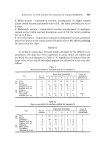
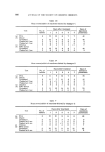
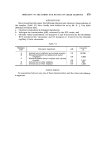
IRRITANCY TO THE RABBIT EYE MUCOSA OF CREAM SHAMPOOS 677 MRs. S. M. LUDFORD: When I first looked at your paper and glanced down your mean scores in the tables, I came to conclusions about the relative irritancy of these products and was somewhat surprised to find this was very different frons your conclusions. When I looked back I found this was due to the maximum persistence in days. The actual scores do not seem very different in fact shampoo B has, if anything, slightly higher mean scores than shampoo A. Could you comment on the score value? I would have expected a higher mean score value if the persistence was longer. MR. R. E. DAVIES: I was always taught that you can prove anything with mathe- matics. The actual scores are relatively unimportant it is the interpretation of the results and the reactions you observe that are important. The essential facts are that xvith shampoo B the cornea was not damaged, and therefore we can say that the potential irritancy of this product is considerably less than with the other shampoo formulations. Admittedly there was extensive conjunctival reaction, but the import- ance of this is dubious in the rabbit, which has well-developed conj unctival structures compared with man and other species. The interpretation of the observed reactions must, therefore, place shampoo B lower on the hazard list than shampoos which irritate the cornea of the eye. MRS. S. M. LUDFORD: Does this mean that the mean score does not really mean very much that you should not perhaps take much notice of it? MR. R. E. DAvms: Mean scores are of value. If we are comparing two products that affect only the conj uctivae, then a difference in the mean scores is of real meaning. If we are comparing two products, one with a higher conjunctival score but no effect upon the iris and cornea, and the second which has possibly greater penetrating powers and causes extensive corneal damage, but with relatively little effect upon the conjuctivae, I would discard the one that damaged the cornea. The Draize scoring system is, in fact, deliberately weighted to give higher scores for corneal and iridial responses, but there will obviously be instances that are not covered, and this will probably always be so with a mathematical system unless it becomes very elaborate. MR. W. S. BEACH: In determining whether there is any predictive value to the tests given, you conceded the point that the behaviour of rabbit eyes is not necessarily identical with that of human eyes. You then went on to say that if you use a set of values for one particular substance as basis, you can predict the behaviour in human eyes of another substance based on its behaviour with rabbits. I would like to suggest that this is improbable or of dubious value, because you have no grounds for supposing that because A reacts this way with rabbits and produces a certain reaction in humans, because B reacts this way with rabbits, by comparison with A it is bound to be just as bad with humans. MR. lq. E. DAVIES: I do not use the word "probable", I say "possible". I would like to know the exact formulation of each test material, and eventually we hope to correlate this with the effects upon the eye. Knowledge of the physiological and other differences between the rabbit and human eyes would then permit more realistic interpretations of hazard-in-use. At the present time we are in a very dubious position to do any predictive comparisons. However, we do need a guide line, and it

678 JOURNAL OF THE SOCIETY OF COSMETIC CHEMISTS does seem that the rabbit test can be of value here. With all animal tests we should never be too dogmatic about our assertions as to what effects the product will eventu- ally have in man he is a different animal species. MR. A. FOSTER: What exactly did you use as a criterion of choice in the shampoos selected? Was it purely a matter of physical state? MR. R. E. DAVIES: We accept the advice of the Toxicology Committee of the Society as to the cream shampoos that held the "lion's share" of the commercial market in Britain at that time. The chemical and physical nature was not considered at that time this was a secondary interest. MR. A. FOSTER: The decision, then, as to what was a cream shampoo was not yours? MR. R. E. DAVIES: NO. DR. A. W. MIDDLETON: You have assembled your rating results into what you call mean scores, and therefore, for your mean scores to be any valid measure of the total effect, the differences in the steps of your rating scale must be equal. What steps have you taken to make sure that these are equal? Is the difference between non-irritant and slightly irritant at one step, the same difference as that between moderately irritant and severely irritant? MR. R. E. DAVIES: In these studies we used standard test procedures which we have quoted at the beginning of our paper. These tests have defined results which are, admittedly, very limited. There is no division into slight, mild, moderate and severe irritants. In the FDA test the product is defined as an "irritant" if it produces a positive test result, and the Draize test defines only "severe irritants". In our study we have interpreted the results as defined in the test procedures. The classification chart given in the paper is one devised by us in an attempt to categorise products more realistically. It is a purely arbitrary system and is used only as a guideline. Your comments on mean scores, I think, have already been covered. They are of value in certain situations. MR. E. A. GOODE: Cream shampoos have now been on the market for many years. I do not know whether some people have suffered damage but has any opinion been expressed in the medical press as to whether there is a severe problem here? MR. R. E. DAVIES: •¾e do not receive details of consumer complaints routinely and they are not widely publicised possiblybecause, as Mr. Pugh indicated, they do not exist. It could well be that the users of cream shampoos do not experience ocular irritation. I certainly have not seen the medical profession called in on this. DR. K. H. HARPER: I jUSt want to make the point that we have used a form of abbreviation in presenting the tables. Mean scores are based on reactions in three different parts of the eye, and I think it is arguable that this is not justified because of the different degree of importance that is attached to the different structures. It would have been more correct for us to have reported mean scores for cornea, iris and conjuctivae separately, but this would have made the tables three times as big, and for this reason we decided to abbreviate. I think it is a very valid criticism that the abbreviation is perhaps misleading in this instance.
Purchased for the exclusive use of nofirst nolast (unknown)
From: SCC Media Library & Resource Center (library.scconline.org)