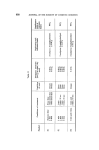
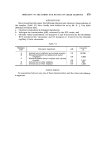
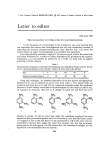
J. Soc. Cosmetic Chemists 18 693-694 (1967) (•) t907 Society of Cosmetic Chemists of Great Britain Letter to editor 12th July 1967 THE SEPARATION OF NITRO-DYES BY ELECTROPHORESIS In the discussion of a recent paper in the Journal (1), one of us reported that our experience had shown that electrophoresis was the only satisfactory method of separating the isomeric nitrophenylenediamine dyes. Brown's Fig. I (1) shows the typical failure of paper chromatography to accomplish this separation. Our electrophoretic technique employs 1 M aqueous acetic acid as the electrolyte and either Whatman No. 1 paper or Gelman Sepraphore III gel strips as the support. Separations can conveniently be performed on a 15~20 cm strip with an applied potential of 10-50 volts/cm. Table I Electrophoretic separation of nitrophenylenediamines on a Sepraphor III gel strip for 45 min under a potential gradient of 10 volts cm -1 using 1 M acetic acid as the solvent. , Dye I II III IV V Distance travelled (mm) 0 13 18 35 85 Using this technique, an excellent separation of the five known nitrophenylene- diamines (I-V) can be achieved as can be seen from Table I. Very sharp bands are produced and those due to II and III are completely separable under the conditions employed. In the initially developed electrophoretogram all the bands are yellow but, on exposure to ammonia, that due to V changes to brick red and that due to II NH2 NO I II III IV V changes to orange. It will be noted that under the conditions employed the dyes migrate as their protonated species and it is of interest to note that the failure of dye I to migrate is due to the fact that it is not protonated in 1 M acetic acid--due un- doubtedly to the fact that, unlike the other four isomers, this dye has no amino- group meta to the nitro-group. For this reason also, the technique is suitable for the separation of m-nitroaniline from its isomers. 693

694 LETTER TO EDITOR OH OH OH OH NO 2 NH 2 NO• NHCH• VI VII VIII IX Other nitro-dyes which are commonly employed in hair colour products are the nitroaminophenols (VI-IX). Of these, only compound VI migrates under the con- ditions described above. The remainder are conveniently separated by chromato- graphic techniques. J. F. CORBETT and A. G. FOOKS Gillette Research Laboratory, Reading, Berks. REFERENCE (1) Brown, J. C. J. Soc. Cosmetic Chemists 18 225 (1967)
Purchased for the exclusive use of nofirst nolast (unknown)
From: SCC Media Library & Resource Center (library.scconline.org)