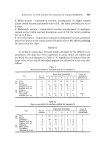
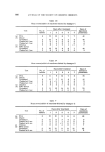
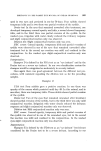
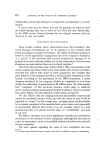
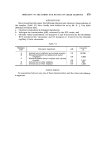
IRRITANCY TO THE RABBIT EYE MUCOSA OF CREAM SItAMPOOS C3•9 oped in two eyes and persisted in one for 70 days. Four rabbits showed temporary iritis and in two there was partial eversion of the eyelids. Draize test: In the eyes that remained unwashed after treatment, one developed temporary corneal opacity and iritis, a second showed temporary iritis, and in the third there was partial eversion of the eyelids. In the washed eyes, irrigation with water clearly reduced the irritancy response and slight conjunctival reaction only was observed. Dilution test: Slight conjunctival reaction only was seen. HRC screen: Corneal opacity, temporary iritis and partial eversion of eyelids were observed in one of the eyes that remained unwashed after treatment but in the second eye reaction was mild and confined to the conjunctivae. In the washed eyes slight conjunctival reaction only was observed. Interpretation: Shampoo D is defined by the FDA test as an "eye irritant" and by the Draize test as a severe eye irritant. In our own classification system the shampoo would be categorised as moderately to severely irritant. Once again there was good agreement between the different test pro- cedures, with comment regarding the dilution test as for the preceding samples. Shampoo E FDA test: Four rabbits gave a positive reaction. In one there was opacity of the cornea which persisted until day 45. In this animal, and in one other, there was temporary iritis. Three rabbits showed partial eversion of the eyelids. Draize test: Two of the eyes that remained unwashed after treatment showed partial eversion of the eyelids, but in the third there was only mild conjunctival reaction. Irrigation with water clearly reduced the irritancy response and slight conjunctival reaction only was observed. Dilution test: Mild conjunctival reaction only was seen. HRC screen: Corneal opacity, temporary iritis and partial eversion of the eyelids was observed in one of the unwashed eyes, but in the second the reaction was mild and confined to the conjunctivae. In the washed eyes slight conjunctival reaction only was observed. Interpretation: Shampoo E is defined by the FDA test as an "eye irritant" but it is not considered by the Draize test to be a severe irritant. According to our

670 JOURNAL OF THE SOCIETY OF COSMETIC CHEMISTS classification system, this shampoo is categorised as moderately to severely irritant. It can be seen that the Draize test and the dilution test failed to show the iridial damage that was revealed by the FDA test and, fortuitously, by the HRC screen. Corneal damage was an atypical reaction, and was observed in only one rabbit. DISCUSSION AND CONCLUSIONS These studies confirm earlier observations from this laboratory that cream shampoo formulations are to be regarded as eye irritants when tested according to accepted procedures. The degree of irritancy produced, however, varies appreciably ranging from the severe responses elicited by A, C and D, to the relatively mild reaction produced by shampoo B. In general, the results obtained confirm our earlier observations (1) that cream shampoos are more irritant than are the liquid varieties.* The study also provides clear evidence that a 10% concentration of the cream is much less irritant than is the cream itself, and of course we believe that this fact will be duly noted by those proponents who consider that prior dilution of the shampoo provides a more practical assessment of user hazard. According to one participant at the 1963 Symposium, a cream shampoo marketed by his company elicited no complaints in two years during the marketing of approximately 35 million doses. We must assume that "complaint" in this particular instance would apply to relatively severe reaction, perhaps necessitating medical treatment, and it is probable that minor degrees of scalp irritation would remain unreported. We also believe that the stinging sensation and possible conjunctivitis caused by accidental contact of the eye with the cream or suds would be regarded as "normal" by the average user, and again there would probably be no formal complaint to the manufacturer unless vision was temporarily or permanently affected. How many of us, for example, report to a soap manufacturer the very painful reaction when we "accidentally" get soap in our eyes. We believe, therefore, that undue significance should not be attached to the absence or low incidence of user complaints, although this fact must of course be reassuring in so far as it probably indicates freedom from seriously adverse properties. The same opinion regarding the value of user complaints has been • It is hoped that additional data to support this will be available in time for the meeting.
Purchased for the exclusive use of nofirst nolast (unknown)
From: SCC Media Library & Resource Center (library.scconline.org)