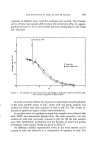
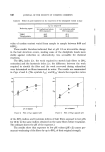
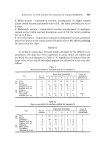
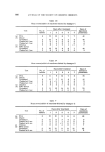
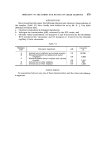
IRRITANCY TO THE RABBIT EYE MUCOSA OF CREAM SHAMPOOS 671 advanced somewhat more forcefully by Maibach and Epstein (3) who aver that "iust as most of the volume of an iceberg hides beneath the surface, complaint letters indicate but a minute fraction of the total problem". If this view is correct, then in the interest of public safety we must be guided, to a great extent, by the outcome of our experimental tests - why else do them? - and in this instance they tell us that all of the creams tested are potentially irritant to the eye mucosa, some dangerously so it follows, therefore, that unless appropriate remedial steps are taken to remove any neat shampoo that is accidentally instilled into the eye, there is a theoretical danger of ocular damage associated with use of these formulations. The animal tests then expose the potential risk to the user. The manu- facturer must weigh this theoretical risk against his assessment of the danger in practice and decide whether or not a user hazard is indicated. Since all of the five products tested in the present study presumably enjoy a success- ful commercial life, it must be assumed that the manufacturers have decided correctly. Comparison of the results obtained with the various test procedures again indicates that the best cover is provided by the 6 rabbit FDA Test. We still maintain, however, that inclusion of an additional group of, say, three rabbits, in which the eye is irrigated with water, is necessary to safe- guard against the rare occurrence of increased irritancy resulting from the procedure. We ourselves have experience of one such product (1) and Leven- stein (4) has drawn attention to the fact that with 0.1% sodium lauryl sulphate "you have the lowest activity, the greatest reaction, and most trouble". In all cases that •ve have studied, prior dilution of the cream shampoo has clearly failed to allow the full irritancy potential of the cream to be realised. In this respect, therefore, it may be considered to provide a relatively insensitive test procedure. It does not follow, however, that it is of no value as a predictive test and it is arguable that it does in fact provide the more practical assessment of hazard under normal user conditions. At this point the dilemma is all too obvious. Do we follow the normal pattern of classical toxicology and select the test that provides the most stringent conditions and allows the full toxicity of the product to be made apparent, or do we merely seek an animal model that attempts to simulate as closely as possible the conditions of practical usage. Fortunately, it is not the purpose of our communication to debate this problem since in our title we have been most careful to refer to "potential irritancy". However, we cannot ignore the question completely and would like to take this opportunity to express our belief that assessment of risk can only

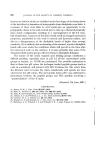
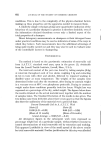
672 JOURNAL OF THE SOCIETY OF COSMETIC CHEMISTS come from a full understanding of the intrinsic toxicity of a material. Further tests may then be required to assess safety-in-use under specified conditions, but at least we should be fully aware of any damage the com- pound is capable of causing. According to Cainan (5) "every manufacturer of a therapeutic or cosmetic product takes a calculated risk (though he may not always be conscious of it) when he puts his product on the market". Our tests clearly place cream shampoos within the same category. (Received: 6th September 1966.) REFERENCES (1) Gaunt, I. F. and Harper, K. H. J. Soc. Cosmetic Chemists 1,• 209 (1964). (2) Draize, J. H. Dermal Toxicity. in Appraisal of the Safety of Chemicals in Foods, Drugs and Cosmetics (1959). (Assoc. Food & Drug Officials U.S., Austin, Texas). (3) Maibach, H. I. and Epstein, W. L. Toxicol. Appl. Pharmacol. ? 39 (1965). (4) Levenstein, I. J. Soc. Cosmetic Chemists 1õ 209 (1964). (5) Cainan, C. D. Defining Potentially Hazardous Substances in Cosmetics and Topical Medications. in The Evaluation of Therapeutic Agents and Cosmetics(1964)(McGraw- Hill, London). DISCUSSION Me. C. Pu•m I think it is important to take into account the physical character- istics in assessing the relation between rabbit tests and hmnan experience. In the last eight years I have seen three letters from people who have accidentally splashed liquid shampoos into their eyes. Each of them has described their reactions rather like a mild irritation in the Draize test, but they all cleared up within three or four days. Although sales of thick cream shampoos are high enough to produce this sort of result, I have not yet seen any letter from a user of a cream sha•npoo com- plaining of getting it in their eyes. I am sure this is because it is much more difficult. It is fair to say that shampoo users in general either dilute their shampoos, or dunk their hair in water and then apply the neat shampoo. In these conditions it is much more difficult to get a cream shampoo into the eye than a liquid one. Cream shampoos may be more irritant in the Draize test, but in use they are probably less of a hazard than liquid shampoos. Me. R. E. DAWES: •Ve can but agree with you. Our preliminary studies indicate that the physical nature of a shampoo is an important contribution to its safety-in-use. It is certainly reassuring to hear that cream shampoos in general use do not present a hazard. I would stress, however, that as toxicologists we are also interested in the potential irritancy of a shampoo. •Ve have to bear in mind that people are using these shampoos possibly directly from the bottle, and there is the chance that some may accidentally enter the eye in an undiluted form. A function of the rabbit test is to indicate the type of reaction that can be produced by a shampoo entering into the eye. We always regard your comments about consumer complaints with some interest, although unfortunately these data are not generally made available to us, and therefore we are not in a position to comment further on your findings. Nevertheless, it is
Purchased for the exclusive use of nofirst nolast (unknown)
From: SCC Media Library & Resource Center (library.scconline.org)