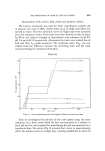
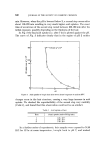
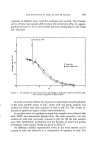
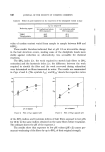
THE BEHAVIOUR OF HAIR AT LOW PH VALUES 649 DISCUSSION The results of this investigation indicate that exposure to low pH values induces some drastic structural changes in hair. The exact nature of these changes is not clear but it appears that it does not involve fission of the main polypeptide chains. The time dependence of the acid uptake curve (i.e. long delay followed by a sudden change) suggests that the processes responsible for the observed phenomenon are of a cooperative nature. A possible explanation is that the prolonged exposure to acid induces the rupture of bonds, strategically situated in the keratin fibre, as a consequence of which a rapid opening up of regions, hitherto inaccessible to acid penetration, follows. When investi- gating the supercontraction of wool, induced by LiBr, Crewther (5) came to the conclusion that the second stage of the super-contraction can be induced by dissociating acid-labile groups which exist in virgin keratin fibres. He suggested that these groups are disulphide linkages, which are under stress in the native protein fibre, and consequently highly susceptible to chemical attack. Benesch and Benesch (6) showed that simple, low molecular weight disulphide compounds undergo dissociation in strong acids (6M HC1) according to the following reaction scheme: I R-S-S-R d- HC1 --• R-S-S-R --• RS+ d- HS-R .. (I) C1- C1- Furthermore, Crewther (5) also suggested that in the case of the stressed disulphide bonds of keratin fibres it is highly probable that the reaction even occurs at values around pH 1, thus accounting for acid lability of some disulphide bonds. Our results are in general agreement with this hypothesis and lend further support to it. The absence of the changes in acid-treated hair, such as are induced in virgin hair by exposure to acid, and the diminish- ing of the rate of disulphide reduction in acid treated hair (the lowering of the rate of disulphide reduction observed in acid treated hair suggests that the reactive disulphide bonds amount in virgin hair to about 6% of the total disulphide content), and the reduction in the value of I20, all support the above model. The acid-labile disulphide bonds, once dissociated, will not recombine again, or at least not in the same way as they existed in the virgin fibre, especially if their configuration in the virgin fibres is not ther- modynamically the most favoured one. It is highly probable that during the growth of the fibre, internal

650 JOURNAL OF THE SOCIETY OF COSMETIC CHEMISTS stresses are built in which are stabilised at the last stages of the biosynthesis of the hair fibre by formation of interpeptide chain disulphide cross links. A severance of these cross links by acid would give an opportunity to the polypeptide chains in the acid-treated hair to take up a thermodynamically more stable configuration resulting in a rearrangement of the S-S cross- link distribution. A process of this kind would result in changed mechanical properties, manifested by the work to stretch and hysteresis indices, and also in a disappearance of the disulphide bonds of higher than average reactivity. (It is unlikely that a reforming of the stressed, reactive disulphide bonds •vill occur under the conditions which will prevail in the fibre after the removal of acid on the contrary, it is more probable that some of the dissociated half cystine groups will not reform to disulphide linkages) The nature of the newly exposed acid binding groups constitutes a difficult problem, especially since at pH 1.2 all the conventional acidic groups in keratin, i.e. COOH are protonated. One possible explanation is that at these low pH values the hydrogen bonded peptide groups (such as exist in a a-helices), will interact with HC1. Evidence for this exists from the titration curve of nylon (7), where considerable acid uptake has been observed at low pH values. The acid uptake below pH 1 was attributed to interactions between the peptide groups and HC1, possibly involving a "quaternization" of the N atom. (Received: 7th June 1967.) REFERENCES (1) Breuer, M. M., J. Phys. Chem. 08 2067 (1964) (2) Hille, E., Blochem. Z., 1181 220 (1959) ibid. 111111 269 (1960) (3) Zahn, H. and Trauman, K., Deut. Wollforschungs Institut. 6 (1965) (4) Jenkins, A. P. and Wolfram, L.J., J. Soc. Dyers Colourists, 80 65 (1964) (5) Crewther, W. G., J. Polymer Svi., 2A 131 (1964) (6) Benesch, R. E. and Benesch, R., J. Amr. Chem. Sot., 80 1666 (1958) (7) Mathieson, A. R., Whewell, C. S. and Williams, P. E., J. Appl. Polymer Svi., 8 2009, (1964)
Purchased for the exclusive use of nofirst nolast (unknown)
From: SCC Media Library & Resource Center (library.scconline.org)