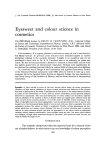
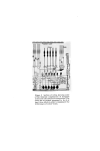
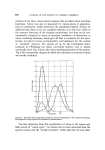
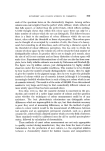
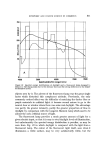
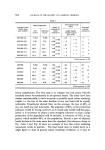
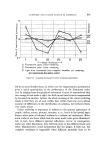
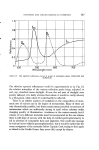
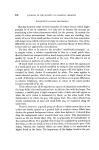
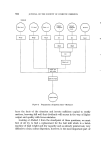
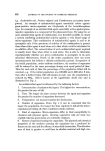
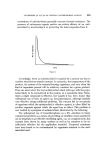
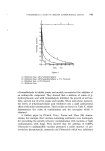
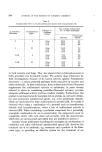
EYESWEET AND COLOUR SCIENCE IN COSMETICS 517 1.0 IBG / \ i i \ I I \ I \ \ ! \ 0.8 0.6 0.4 0.2 400 500 600 700 W•v½[½ngth (nm) Figure 13 The spectral reflectance curves of a pair of metameric greys, I(BG)-I(R) and •(B) 4Z(¾). The effective spectral reflectances would be approximately as in Fig. 13, the relative intensities of the various reflection peaks being adjusted to suit, say, standard mean daylight. If now the red part of daylight were greatly reduced, it is fairly obvious that colour A would be vastly altered, to a blue-green, while colour B would hardly be affected. There is an infinite number of variations in the composition of meta~ merle sets of colours and in the degree of metamerism. Many of these are only theoretically possible, but there remain many practical occurrences of metamerism which are sufficiently strong to spoil colour schemes under changing quality of illumination. Avoidance is the easiest remedy, but if colours of very different materials must be incorporated in the one scheme there is still hope of success with the help of careful spectrophotometry to aid in selection of compatible dyes and pigments. One could also manage by trial and error without spectrophotometry, but it would be rather like the ocean navigators of the centuries before Captain Cook trying to find again an island in the Pacific Ocean: they never did, except by chance.

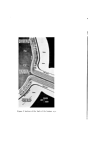
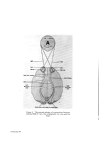
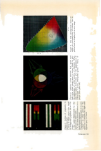
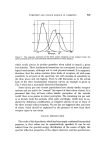
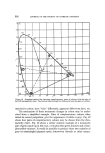
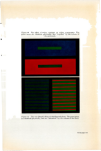
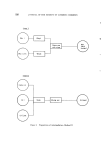
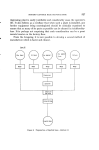
518 JOURNAL OF THE SOCIETY OF COSMETIC CHEMISTS SUBJECTIVE COLOUR PHENOMENA Having sketched some of those branches of colour science which might possibly be of use in cosmetics, it is only fair to balance the account by mentioning a few colour phenomena which, for the present, lie outside the realm of colour measurement. Some are subtle, some are startling, they nearly all occur when small patches of colour are viewed in close association with larger areas which contrast strongly in colour or luminance. One of the difficulties in the way of putting forward a universal theory of these effects is that some are apparently contradictory. The first effect to be noted is the so-called "small-field tritanopia", or, in simpler terms, a relative insensitivity to blue in a small patch when directly fixated as compared with a much larger patch of the same physical 2 o quality («ø versus or over, subtended at the eye). This effect is not of great interest in patterns of surface colours. Of much wider occurrence is the contrast effect in which the appearance of a small patch may be greatly modified by being in close association with a larger patch. For example, a small patch of grey will look lighter if sur- rounded by black, darker if surrounded by white. The same applies to small coloured patches, which show, in some cases, a slight change in hue as well. If the large surrounds are coloured, but there are no great differences in relative brightness, then modifications in colour of the small patches become noticeable (Fig. 14). These effects may all be regarded as aspects of adaptation controlled by the large fields: the small patches have to fall into line with the larger. For instance, a middle grey is light compared with a black and will appear so when the eye's vision is dominated by black on the other hand, if the domination is by white, the grey will appear dark. The colour effects from simple combinations of large and small fields may be explained along the same lines. There is, however, a special group of effects in which narrow lines of one colour are closely spaced on a general field of another colour. Black lines darken the general background colour, white lines lighten it. Coloured lines drag the background colour towards their own colour. This phenomenon, known as the yon Bezold effect (Fig. 15), is apparently in contradiction to the contrast effects. It is possible that it may be explained by scattering in the retina, in the eye media in front of the retina, or from part to part of the retina, whereas the contrast effects are more likely to be motivated at higher levels in the brain. The importance of the higher levels in the per-
Purchased for the exclusive use of nofirst nolast (unknown)
From: SCC Media Library & Resource Center (library.scconline.org)