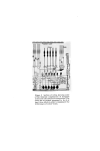
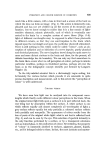
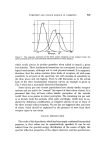
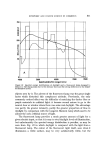
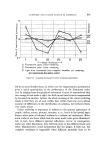
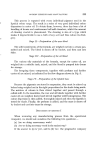
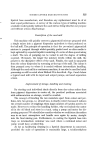
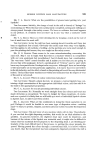
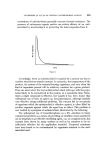
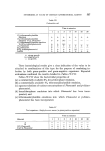
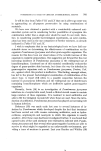
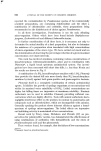
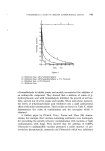
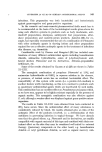
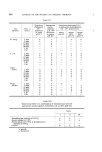
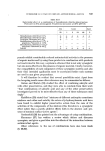
EYESWEET AND COLOUR SCIENCE IN COSMETICS 515 10ø/o 5ø/ø 1.0 lOO/o 0.5 I II III IV v vI • Band Numbers --"-'• (Z) FJuor½sccnt: good co[our rendering • FJuor½scent: poor co,our rendering El Light bJu½ f•uor½sccnt pJus tungsten: ½xccJJcnt col rendering All i•Juminants the same cotour Figure 11 Graphical portrayal of colour rendering assessments. left in its more detailed form, in which case the diagrammatic presentation gives a quick appreciation of the performance of the illuminant under test. In judging from the graphical assessment it must be remembered that two wrongs do not make a right: too little in one band is never compensated by too much in another. Indeed, the whole meaning of the colour rendering bands is that they are of such widths that within them the eye is almost unaware of differences in the distribution of radiation, but between them, very much aware. Colour rendering is important in relation to the general appearance of people, clothes, scenes, pictures, interiors, a.s.o., but it is has special signi- ficance when pairs of coloured surfaces in a scheme are metameric. Meta- meric surfaces are those which look the same under some given illuminant, but, in fact, have different spectral reflectance curves: in consequence, under any other illuminant, they will look more or less different from each other. Manufacturers avoid metamerism like the plague, if they can, but complete avoidance is impossible when different materials have to be

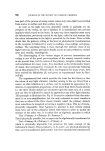
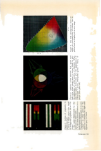
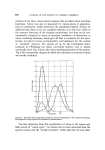
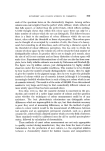
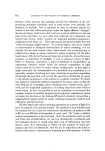
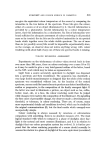
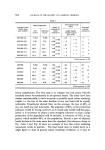
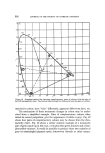
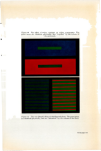
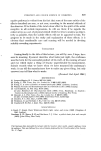
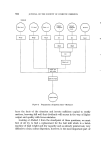
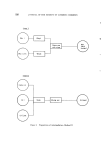
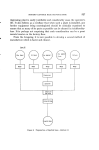
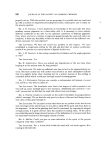
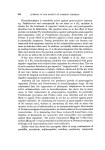
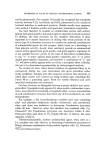
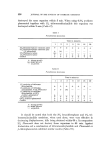
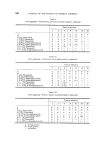
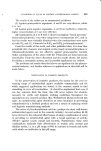
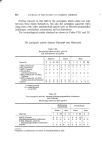
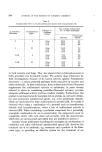
516 JOURNAL OF THE SOCIETY OF COSMETIC CHEMISTS 520 'sos [ 0-9 0-8 0-7 0.6 0,5 0.4 0.3 0.2 0,1 0 0.1 0.2 0.3 0-4 0.5 0.6 0.7 0.8 Figure 1• Graphical method for choosing complementary pairs of colours with the help of the CIE chrornaticity chart. The broken lines through the white point join the pairs of colours. matched in colour dyes "take" differently, pigments differ from dyes, etc. The mechanism of these metameric changes in colour may be under- stood from a simplified example. Pairs of complementary colours, when mixed in correct proportion, give the appearance of white or grey. Fig. 1oe shows how pairs of complementary colours may be chosen from the chro- maticity chart. Fig. 18 shows a rather extreme example of a metameric pair of greys made up in this way, a red-plus-blue-green mixture and a blue- plus-yellow mixture. It would be possible to produce these two varieties of grey by intermingled pigment spots, interwoven threads or other means.
Purchased for the exclusive use of nofirst nolast (unknown)
From: SCC Media Library & Resource Center (library.scconline.org)