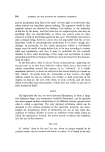
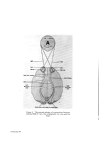
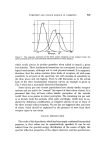
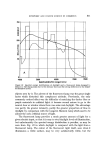
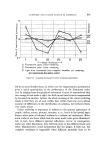
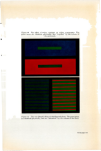
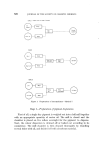
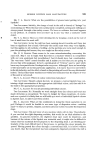
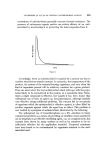
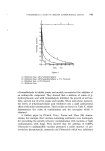
532 JOURNAL OF THE SOCIETY OF COSMETIC CHEMISTS e.g. Escherichia coli, Proteus vulgaris and Pseudomonas pyocyanea (aeru- ginosa). An example of antimicrobial agents essentially active against gram-positive micro-organisms are bis-phenols of the hexachlorophane type. An example of an antimicrobial agent essentially active against gram- negative organisms is a compound of the phenoxetol type. By using two or more antimicrobial agents in combination, it is therefore possible to obtain a system exhibiting antimicrobial activity against a very broad range of micro-organisms. This combination of antimicrobial agents is said to be synergistic only if the spectrum of activity of the combination is greater than when either agent is used alone or to that which could be attributed to an additive effect. The concentration of each antimicrobial agent required is usually lower than when either is used alone. One is able to determine experimentally whether any given combination is synergistic in its anti- microbial effectiveness. Death of the entire population does not occur instantaneously but follows a definite predictable pattern. Irrespective of the initial population, under uniform conditions, the number of organisms will be reduced by the same percentage during each equal period of time. Thus for each unit of time the percentage of the population killed will be constant, e.g. if the initial population was 100,000 and 1,000 after 5 min, then after a further 5 min, 100 will remain in each case the populations is reduced by 90%. This is known as the logarithmic death rate and is illustrated by Fig. 1. An antimicrobial agent is influenced by the following factors: 1. Concentration of antimicrobial agent. The higher the concentration, the greater the rate of kill. 2. Time. The longer the time contact between the agent and organism the greater the number of organisms destroyed. :3. Temperature. An increase hastens the destruction. 4. Number of organisms. From Fig. I it can be concluded that the larger the population, the longer the time required to kill all the micro- organisms providing all other conditions remain uniform. 5. Kind of organisms. Micro-organisms differ in their susceptibility to chemical and physical agents. Growing vegetative cells are most sus- ceptible whereas spore forms are extremely resistant. 6. Nature of material bearing the organisms. The physical and chemical properties of the medium carrying the organisms has a profound in- fluence on the rate and the efficacy of microbial destruction. The effective- ness of heat is greater in acid than in alkaline material and high con-

SYNERGiSM IN VITRO OF CERTAIN ANTIMICROBIAL AGENTS 533 centrations of carbohydrates generally increase thermal resistance. The presence of extraneous organic matter can reduce efficacy of an anti- microbial by inactivating it or protecting the micro-organism from it. Time Figure I Accordingly, when an antimicrobial is required for a system one has to consider what factors remain constant. In cosmetics, the temperature of the product, the nature of the material-bearing organisms, and very often the kind of organisms present will be relatively constant for a given product. Thus one must select the best antimicrobial which will cope with the popu- lation likely to be encountered in the system, in a reasonable time. Some- times a single compound is effective, but usually it has been found that widespread use of such an agent e.g. hexachlorophane, although initially very effective, brings additional problems. The vacuum left by one species of organisms which the antimicrobial is effective against, is often filled by another organism against which the agent has no effect. This problem is now tackled by synergism of antimicrobials, illustrated by the following: The widespread use of hexachlorophane as a 3% emulsion in many commercial products as a means of providing an emulsion cream system for use in hospitals as an effective sterilising agent, e.g. as a surgical scrub, has recently been shown by many workers as well as by ourselves to be in- sufficiently effective for the application intended. Unopened containers have been found to be contaminated by organisms resistant to the anti- microbial used.
Purchased for the exclusive use of nofirst nolast (unknown)
From: SCC Media Library & Resource Center (library.scconline.org)