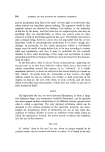
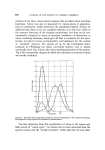
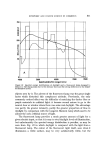
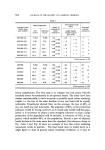
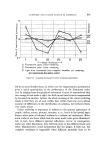
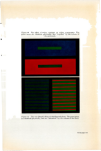
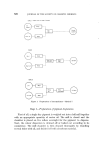
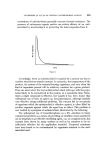
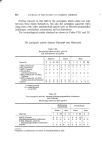
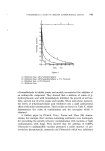
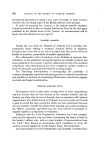
542 JOURNAL OF THE SOCIETY OF COSMETIC CHEMISTS reported the contamination by Pseudomonas species of two commercially available preparations, one containing chlorhexidine and the other a combination of chlorhexidine and cetrimide, these preparations being recommended as the disinfectants of choice against Pseudomonas. In all these investigations, Pseudomonas is not the only offending micro-organism. Others which have been found include Staphylococcus pyogenes, Escherichia coli and different Salmonella strains. In further consideration of all these facts, it is necessary not only to determine the actual sterility of a final preparation, but also to determine the resistance of a preparation when inoculated with high concentrations of micro-organisms of the above type. We have carried out much work on the determination of observing the percentage reduction of a given inoculant concentration over short intervals. This work has involved emulsions containing various concentrations of hexachlorophane, tribromosalicylanilides, alone and in combination with Phenonip*, a liquid broad spectrum antimicrobial system. Our investi- gations have been concerned with short time kills, i.e. less than 10 min and the results are shown in Fig. 2. A combination of a 3% hexachlorophane emulsion with 1.0ø/0 Phenonip thus provides the desired kill rate more closely than 3% hexachlorophane emulsion by itself, against both gram-positive and gram-negative bacteria. Phenonip itself is a synergistic combination of certain antimicrobial agents. It inhibits the growth of spoilage organisms at concentrations well within its maximal water miscibility of 0.50/0 . Lethal concentrations are higher but killing times are impressive at maximum solubility. Nonionic surfactants can be used to solubilise Phenonip providing sufficient con- centrations which are highly effective. Tests with anionic surfactants had a negligible interference effect on the product, in contrast to quaternaries and compounds such as chlorohexidene, which are incompatible with anionics. Generally speaking the product shows inherent efficiency against a broad- spectrum of spoilage micro-organisms. The lethal effects are impressive and inhibiting activity is maintained at low concentrations. Recent work by Tracy, Glass, Nicholson and Pivnick (17) on pre- servatives for poliomyelitis vaccine, has demonstrated the effectiveness of' using combinations of antibiotics with formaldehyde, and the esters of p-hydroxybenzoic acid and the phenoxetols. These workers found, for example, that the failure of low concentrations *Phenonip: based on p-hydroxybenzoates

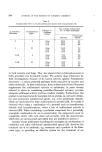
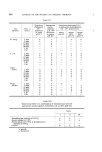
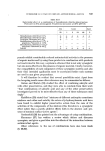
SYNERGISM IN VITRO OF CERTAIN ANTIMICROBIAL AGENTS 543 D 0 --e ' ß • I0 2O 30 • 40 •' 50 • •o • ,o 8O 25 o I000 5 I0 15 20 35 40 Time, min Figure 2 A--Emulsion base +3 •o hexachlorophane B--Emulsion base +3 % hexachlorophane + 1 •o Phenonip C--Emulsion base q-1 •o Phenonip D--Emulsion base of formaldehyde to inhibit yeasts and moulds necessitated the addition of an antimycotic compound. They showed that a mixture of esters of p- hydroxybenzoic acid with formaldehyde inhibited the growth of all bac- teria, and six out of seven yeasts and moulds. When used alone, however, the esters of p-hydroxybenzoic acid exhibited only a mild antibacterial effect at the same concentrations. Their results are shown in Table X, which demonstrates the value of combinations and the synergism which is obtained. A further paper by Pivnick, Tracy, Tosoni and Glass (18) demon- strates, for example, that vaccines containing antibiotics were inadequate for preventing the growth of heavy contamination with bacteria or light contamination with fungi. They showed that the addition of 0.375% Phenoxetol to poliomyelitis vaccines presented a stable mixture of pre- servatives (streptomycin, neomycin and Phenoxetol) which was inhibitory
Purchased for the exclusive use of nofirst nolast (unknown)
From: SCC Media Library & Resource Center (library.scconline.org)