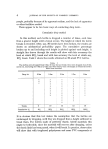
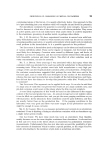
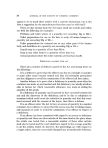
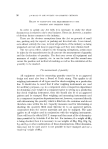
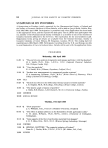
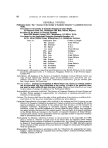
42 JOURNAL OF THE SOCIETY OF COSMETIC CHEMISTS should be affixed to the pack as an incorrect one may contravene some local overseas requirement. The efficiency of the control at all stages must be taken into account. It is no use allowing the glass manufacturer's capacity tolerance unless the components themselves are measured and controlled within the toler- ance. The same applies to variations in filling machine quantities. It is also necessary to control the process to ensure that variations in tempera- ture, aeration, etc., used for the calculations are not exceeded. Probably the most important factor to control is the efficiency of the pack closure. One must ensure that all aerosol containers are sealed and not leaking at any point, tubes are adequately crimped, wad materials are satisfactory and the caps applied with an adequate torque, plastic packs are welded satisfactorily, a.s.o. Another important control factor is the specific gravity of the product if the declared contents and the control method use different units of quantitity measurement, e.g. g to cm 3, oz. to fl.oz., etc. In taking into account all these factors, statistical methods of control are quite acceptable provided they are •vell designed to suit the existing circumstances. What must be borne in mind is that the allowances made, and the control exercised, should be such that one may claim that any packs which are under weight are a genuine mistake or error. It is, however, one's duty to prove this and to show that all reasonable precautions and control had been exercised. At the same time one cannot declare an unduly low figure as overfilling is also an offence and one which requires the offender to prove that the excess filling was necessary to prevent a possibil- ity of underfilling. In other words, one has to be able to justify all the allowances made in the calculation. To this end, methods of control with confidence limits of 99.7% are probably acceptable, although certainly not giving any guarantee of freedom from committing an offence. Methods of calculating the declared fill Rigid plastic bottle, vacuum filled Table IV Factor i Variation Standard fill Container variation in capacity at filling level Accuracy of filling machine Processing losses (de-aeration) Loss on storage (2 yr at 20øC) , _+ lcm3 +•- • +0.4 cm3 1% = 0.9 cm 3 3% = 2.7 cm3 Minimum fill (Standard minus variation) 90 cm3 89 cm 3 88.6 cm 3 87.7 cm3 85 cm 3

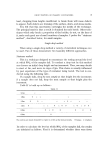
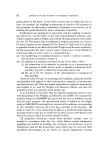
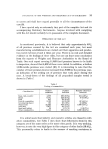
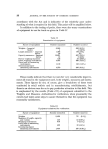
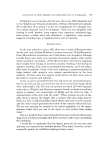
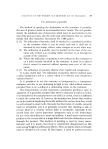
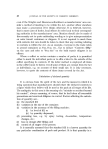
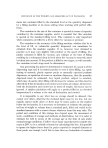
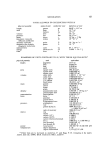
INFLUENCE OF TIlE WEIGHTS AND MEASURES ACT ON I'ACKAGING 43 It is obvious, therefore, that the maximum figure that can be declared assuming all factors to be under control is 85 c.c. and preferable that a safety factor should be allowed and 84 c.c. used. Metal tube, volumetrically filled Table V Factor Standard fill Container variation Accuracy of filling machines Processing losses Loss on storage (2 yr at 20 ø) Variation Not applicable _+0.5g none 0.$% -• 0.7 g Minimum t511 (Standard minus variation) 140 g 140 g 139.5 139.5 138.8 In this case a declared figure of 138 g is quite acceptable. Metal aerosol container with high product and low propellan! fill Table VI Factor Standard fill Container variation Accuracy of filling machint (concentrate) Accnracy of filling machine (propellant) Processing loss (spray testing) I•oss on storage Variation Not applicable 285 _+ 2 g 15+ lg 2g Minimum 'Standard minus 300 g 300 g 298 g 297 g fill variat i• m) 294 g 292 g In theory it should be possible to declare 292 g, but the manufacturer may feel that the filling weight tolerance is not perfectly under control and a safety factor of 1 or 2 g is advisable. These safety factors are at the manufacturer's discretion depending upon personal knowledge of his control techniques and it could well be felt by some manufacturers that this method of calculation is already a belt and braces job. The final minimum fill relates to a minimum size container, filled with the minimum quantity, subjected to the maximum processing loss and maximum storage period. It can be argued, therefore, that the number of packs thus involved is so small as to constitute its own safety factor.
Purchased for the exclusive use of nofirst nolast (unknown)
From: SCC Media Library & Resource Center (library.scconline.org)